
‘Now, pray don’t alarm yourself, my dear,’ said Mr. Pickwick soothingly. ‘There is not the least cause for fear, I assure you. Stand firm, Sam,’ said Mr. Pickwick, looking down.
‘All right, sir,’ replied Mr. Weller. ‘Don’t be longer than you can conweniently help, sir. You’re rayther heavy.’
‘Only another moment, Sam,’ replied Mr. Pickwick.
‘I merely wished you to know, my dear, that I should not have allowed my young friend to see you in this clandestine way, if the situation in which you are placed had left him any alternative; and, lest the impropriety of this step should cause you any uneasiness, my love, it may be a satisfaction to you, to know that I am present. That’s all, my dear.’
‘Indeed, Mr. Pickwick, I am very much obliged to you for your kindness and consideration,’ replied Arabella, drying her tears with her handkerchief. She would probably have said much more, had not Mr. Pickwick’s head disappeared with great swiftness, in consequence of a false step on Sam’s shoulder which brought him suddenly to the ground. He was up again in an instant however; and bidding Mr. Winkle make haste and get the interview over, ran out into the lane to keep watch, with all the courage and ardour of youth. Mr. Winkle himself, inspired by the occasion, was on the wall in a moment, merely pausing to request Sam to be careful of his master.
‘I’ll take care on him, sir,’ replied Sam. ‘Leave him to me.’
‘Where is he? What’s he doing, Sam?’ inquired Mr. Winkle.
‘Bless his old gaiters,’ rejoined Sam, looking out at the garden door. ‘He’s a-keepin’ guard in the lane vith that ‘ere dark lantern, like a amiable Guy Fawkes! I never see such a fine creetur in my days. Blessed if I don’t think his heart must ha’ been born five-and-twenty year arter his body, at least!’
Mr. Winkle stayed not to hear the encomium upon his friend. He had dropped from the wall; thrown himself at Arabella’s feet; and by this time was pleading the sincerity of his passion with an eloquence worthy even of Mr. Pickwick himself.
While these things were going on in the open air, an elderly gentleman of scientific attainments was seated in his library, two or three houses off, writing a philosophical treatise, and ever and anon moistening his clay and his labours with a glass of claret from a venerable-looking bottle which stood by his side. In the agonies of composition, the elderly gentleman looked sometimes at the carpet, sometimes at the ceiling, and sometimes at the wall; and when neither carpet, ceiling, nor wall afforded the requisite degree of inspiration, he looked out of the window.
In one of these pauses of invention, the scientific gentleman was gazing abstractedly on the thick darkness outside, when he was very much surprised by observing a most brilliant light glide through the air, at a short distance above the ground, and almost instantaneously vanish. After a short time the phenomenon was repeated, not once or twice, but several times; at last the scientific gentleman, laying down his pen, began to consider to what natural causes these appearances were to be assigned.
They were not meteors; they were too low. They were not glow-worms; they were too high. They were not will-o’-the-wisps; they were not fireflies; they were not fireworks. What could they be? Some extraordinary and wonderful phenomenon of nature, which no philosopher had ever seen before; something which it had been reserved for him alone to discover, and which he should immortalise his name by chronicling for the benefit of posterity. Full of this idea, the scientific gentleman seized his pen again, and committed to paper sundry notes of these unparalleled appearances, with the date, day, hour, minute, and precise second at which they were visible: all of which were to form the data of a voluminous treatise of great research and deep learning, which should astonish all the atmospherical wiseacres that ever drew breath in any part of the civilised globe.
He threw himself back in his easy-chair, wrapped in contemplations of his future greatness. The mysterious light appeared more brilliantly than before, dancing, to all appearance, up and down the lane, crossing from side to side, and moving in an orbit as eccentric as comets themselves.
The scientific gentleman was a bachelor. He had no wife to call in and astonish, so he rang the bell for his servant.
‘Pruffle,’ said the scientific gentleman, ‘there is something very extraordinary in the air to-night? Did you see that?’ said the scientific gentleman, pointing out of the window, as the light again became visible.
‘Yes, I did, Sir.’
‘What do you think of it, Pruffle?’
‘Think of it, Sir?’
‘Yes. You have been bred up in this country. What should you say was the cause for those lights, now?’
The scientific gentleman smilingly anticipated Pruffle’s reply that he could assign no cause for them at all. Pruffle meditated.
‘I should say it was thieves, Sir,’ said Pruffle at length.
‘You’re a fool, and may go downstairs,’ said the scientific gentleman.
‘Thank you, Sir,’ said Pruffle. And down he went.
But the scientific gentleman could not rest under the idea of the ingenious treatise he had projected being lost to the world, which must inevitably be the case if the speculation of the ingenious Mr. Pruffle were not stifled in its birth. He put on his hat and walked quickly down the garden, determined to investigate the matter to the very bottom.
Now, shortly before the scientific gentleman walked out into the garden, Mr. Pickwick had run down the lane as fast as he could, to convey a false alarm that somebody was coming that way; occasionally drawing back the slide of the dark lantern to keep himself from the ditch. The alarm was no sooner given, than Mr. Winkle scrambled back over the wall, and Arabella ran into the house; the garden gate was shut, and the three adventurers were making the best of their way down the lane, when they were startled by the scientific gentleman unlocking his garden gate.
‘Hold hard,’ whispered Sam, who was, of course, the first of the party. ‘Show a light for just vun second, Sir.’
Mr. Pickwick did as he was desired, and Sam, seeing a man’s head peeping out very cautiously within half a yard of his own, gave it a gentle tap with his clenched fist, which knocked it, with a hollow sound, against the gate. Having performed this feat with great suddenness and dexterity, Mr. Weller caught Mr. Pickwick up on his back, and followed Mr. Winkle down the lane at a pace which, considering the burden he carried, was perfectly astonishing.
‘Have you got your vind back agin, Sir,’ inquired Sam, when they had reached the end.
‘Quite. Quite, now,’ replied Mr. Pickwick.
‘Then come along, Sir,’ said Sam, setting his master on his feet again. ‘Come betveen us, sir. Not half a mile to run. Think you’re vinnin’ a cup, sir. Now for it.’
Thus encouraged, Mr. Pickwick made the very best use of his legs. It may be confidently stated that a pair of black gaiters never got over the ground in better style than did those of Mr. Pickwick on this memorable occasion.
The coach was waiting, the horses were fresh, the roads were good, and the driver was willing. The whole party arrived in safety at the Bush before Mr. Pickwick had recovered his breath.
‘In with you at once, sir,’ said Sam, as he helped his master out. ‘Don’t stop a second in the street, arter that ‘ere exercise. Beg your pardon, sir,’ continued Sam, touching his hat as Mr. Winkle descended, ‘hope there warn’t a priory ‘tachment, sir?’
Mr. Winkle grasped his humble friend by the hand, and whispered in his ear, ‘It’s all right, Sam; quite right.’ Upon which Mr. Weller struck three distinct blows upon his nose in token of intelligence, smiled, winked, and proceeded to put the steps up, with a countenance expressive of lively satisfaction.
As to the scientific gentleman, he demonstrated, in a masterly treatise, that these wonderful lights were the effect of electricity; and clearly proved the same by detailing how a flash of fire danced before his eyes when he put his head out of the gate, and how he received a shock which stunned him for a quarter of an hour afterwards; which demonstration delighted all the scientific associations beyond measure, and caused him to be considered a light of science ever afterwards.
CHAPTER XL. INTRODUCES MR. PICKWICK TO A NEW AND NOT UNINTERESTING SCENE IN THE GREAT DRAMA OF LIFE
The remainder of the period which Mr. Pickwick had assigned as the duration of the stay at Bath passed over without the occurrence of anything material. Trinity term commenced. On the expiration of its first week, Mr. Pickwick and his friends returned to London; and the former gentleman, attended of course by Sam, straightway repaired to his old quarters at the George and Vulture.
On the third morning after their arrival, just as all the clocks in the city were striking nine individually, and somewhere about nine hundred and ninety-nine collectively, Sam was taking the air in George Yard, when a queer sort of fresh-painted vehicle drove up, out of which there jumped with great agility, throwing the reins to a stout man who sat beside him, a queer sort of gentleman, who seemed made for the vehicle, and the vehicle for him.
The vehicle was not exactly a gig, neither was it a stanhope. It was not what is currently denominated a dog-cart, neither was it a taxed cart, nor a chaise-cart, nor a guillotined cabriolet; and yet it had something of the character of each and every of these machines. It was painted a bright yellow, with the shafts and wheels picked out in black; and the driver sat in the orthodox sporting style, on cushions piled about two feet above the rail. The horse was a bay, a well-looking animal enough; but with something of a flash and dog-fighting air about him, nevertheless, which accorded both with the vehicle and his master.
The master himself was a man of about forty, with black hair, and carefully combed whiskers. He was dressed in a particularly gorgeous manner, with plenty of articles of jewellery about him—all about three sizes larger than those which are usually worn by gentlemen—and a rough greatcoat to crown the whole. Into one pocket of this greatcoat, he thrust his left hand the moment he dismounted, while from the other he drew forth, with his right, a very bright and glaring silk handkerchief, with which he whisked a speck or two of dust from his boots, and then, crumpling it in his hand, swaggered up the court.
It had not escaped Sam’s attention that, when this person dismounted, a shabby-looking man in a brown greatcoat shorn of divers buttons, who had been previously slinking about, on the opposite side of the way, crossed over, and remained stationary close by. Having something more than a suspicion of the object of the gentleman’s visit, Sam preceded him to the George and Vulture, and, turning sharp round, planted himself in the centre of the doorway.
‘Now, my fine fellow!’ said the man in the rough coat, in an imperious tone, attempting at the same time to push his way past.
‘Now, Sir, wot’s the matter?’ replied Sam, returning the push with compound interest.
‘Come, none of this, my man; this won’t do with me,’ said the owner of the rough coat, raising his voice, and turning white. ‘Here, Smouch!’
‘Well, wot’s amiss here?’ growled the man in the brown coat, who had been gradually sneaking up the court during this short dialogue.
‘Only some insolence of this young man’s,’ said the principal, giving Sam another push.
‘Come, none o’ this gammon,’ growled Smouch, giving him another, and a harder one.
This last push had the effect which it was intended by the experienced Mr. Smouch to produce; for while Sam, anxious to return the compliment, was grinding that gentleman’s body against the door-post, the principal crept past, and made his way to the bar, whither Sam, after bandying a few epithetical remarks with Mr. Smouch, followed at once.
‘Good-morning, my dear,’ said the principal, addressing the young lady at the bar, with Botany Bay ease, and New South Wales gentility; ‘which is Mr. Pickwick’s room, my dear?’
‘Show him up,’ said the barmaid to a waiter, without deigning another look at the exquisite, in reply to his inquiry.
The waiter led the way upstairs as he was desired, and the man in the rough coat followed, with Sam behind him, who, in his progress up the staircase, indulged in sundry gestures indicative of supreme contempt and defiance, to the unspeakable gratification of the servants and other lookers-on. Mr. Smouch, who was troubled with a hoarse cough, remained below, and expectorated in the passage.
Mr. Pickwick was fast asleep in bed, when his early visitor, followed by Sam, entered the room. The noise they made, in so doing, awoke him.
‘Shaving-water, Sam,’ said Mr. Pickwick, from within the curtains.
‘Shave you directly, Mr. Pickwick,’ said the visitor, drawing one of them back from the bed’s head. ‘I’ve got an execution against you, at the suit of Bardell.—Here’s the warrant.—Common Pleas.—Here’s my card. I suppose you’ll come over to my house.’ Giving Mr. Pickwick a friendly tap on the shoulder, the sheriff’s officer (for such he was) threw his card on the counterpane, and pulled a gold toothpick from his waistcoat pocket.
‘Namby’s the name,’ said the sheriff’s deputy, as Mr. Pickwick took his spectacles from under the pillow, and put them on, to read the card. ‘Namby, Bell Alley, Coleman Street.’
At this point, Sam Weller, who had had his eyes fixed hitherto on Mr. Namby’s shining beaver, interfered.
‘Are you a Quaker?’ said Sam.
‘I’ll let you know I am, before I’ve done with you,’ replied the indignant officer. ‘I’ll teach you manners, my fine fellow, one of these fine mornings.’
‘Thank’ee,’ said Sam. ‘I’ll do the same to you. Take your hat off.’ With this, Mr. Weller, in the most dexterous manner, knocked Mr. Namby’s hat to the other side of the room, with such violence, that he had very nearly caused him to swallow the gold toothpick into the bargain.
‘Observe this, Mr. Pickwick,’ said the disconcerted officer, gasping for breath. ‘I’ve been assaulted in the execution of my dooty by your servant in your chamber. I’m in bodily fear. I call you to witness this.’
‘Don’t witness nothin’, Sir,’ interposed Sam. ‘Shut your eyes up tight, Sir. I’d pitch him out o’ winder, only he couldn’t fall far enough, ‘cause o’ the leads outside.’
‘Sam,’ said Mr. Pickwick, in an angry voice, as his attendant made various demonstrations of hostilities, ‘if you say another word, or offer the slightest interference with this person, I discharge you that instant.’
‘But, Sir!’ said Sam.
‘Hold your tongue,’ interposed Mr. Pickwick. ‘Take that hat up again.’
But this Sam flatly and positively refused to do; and, after he had been severely reprimanded by his master, the officer, being in a hurry, condescended to pick it up himself, venting a great variety of threats against Sam meanwhile, which that gentleman received with perfect composure, merely observing that if Mr. Namby would have the goodness to put his hat on again, he would knock it into the latter end of next week. Mr. Namby, perhaps thinking that such a process might be productive of inconvenience to himself, declined to offer the temptation, and, soon after, called up Smouch. Having informed him that the capture was made, and that he was to wait for the prisoner until he should have finished dressing, Namby then swaggered out, and drove away. Smouch, requesting Mr. Pickwick in a surly manner ‘to be as alive as he could, for it was a busy time,’ drew up a chair by the door and sat there, until he had finished dressing. Sam was then despatched for a hackney-coach, and in it the triumvirate proceeded to Coleman Street. It was fortunate the distance was short; for Mr. Smouch, besides possessing no very enchanting conversational powers, was rendered a decidedly unpleasant companion in a limited space, by the physical weakness to which we have elsewhere adverted.
The coach having turned into a very narrow and dark street, stopped before a house with iron bars to all the windows; the door-posts of which were graced by the name and title of ‘Namby, Officer to the Sheriffs of London’; the inner gate having been opened by a gentleman who might have passed for a neglected twin-brother of Mr. Smouch, and who was endowed with a large key for the purpose, Mr. Pickwick was shown into the ‘coffee-room.’
This coffee-room was a front parlour, the principal features of which were fresh sand and stale tobacco smoke. Mr. Pickwick bowed to the three persons who were seated in it when he entered; and having despatched Sam for Perker, withdrew into an obscure corner, and looked thence with some curiosity upon his new companions.
One of these was a mere boy of nineteen or twenty, who, though it was yet barely ten o’clock, was drinking gin-and-water, and smoking a cigar—amusements to which, judging from his inflamed countenance, he had devoted himself pretty constantly for the last year or two of his life. Opposite him, engaged in stirring the fire with the toe of his right boot, was a coarse, vulgar young man of about thirty, with a sallow face and harsh voice; evidently possessed of that knowledge of the world, and captivating freedom of manner, which is to be acquired in public-house parlours, and at low billiard tables. The third tenant of the apartment was a middle-aged man in a very old suit of black, who looked pale and haggard, and paced up and down the room incessantly; stopping, now and then, to look with great anxiety out of the window as if he expected somebody, and then resuming his walk.
‘You’d better have the loan of my razor this morning, Mr. Ayresleigh,’ said the man who was stirring the fire, tipping the wink to his friend the boy.
‘Thank you, no, I shan’t want it; I expect I shall be out, in the course of an hour or so,’ replied the other in a hurried manner. Then, walking again up to the window, and once more returning disappointed, he sighed deeply, and left the room; upon which the other two burst into a loud laugh.
‘Well, I never saw such a game as that,’ said the gentleman who had offered the razor, whose name appeared to be Price. ‘Never!’ Mr. Price confirmed the assertion with an oath, and then laughed again, when of course the boy (who thought his companion one of the most dashing fellows alive) laughed also.
‘You’d hardly think, would you now,’ said Price, turning towards Mr. Pickwick, ‘that that chap’s been here a week yesterday, and never once shaved himself yet, because he feels so certain he’s going out in half an hour’s time, thinks he may as well put it off till he gets home?’
‘Poor man!’ said Mr. Pickwick. ‘Are his chances of getting out of his difficulties really so great?’
‘Chances be d——d,’ replied Price; ‘he hasn’t half the ghost of one. I wouldn’t give that for his chance of walking about the streets this time ten years.’ With this, Mr. Price snapped his fingers contemptuously, and rang the bell.
‘Give me a sheet of paper, Crookey,’ said Mr. Price to the attendant, who in dress and general appearance looked something between a bankrupt glazier, and a drover in a state of insolvency; ‘and a glass of brandy-and-water, Crookey, d’ye hear? I’m going to write to my father, and I must have a stimulant, or I shan’t be able to pitch it strong enough into the old boy.’ At this facetious speech, the young boy, it is almost needless to say, was fairly convulsed.
‘That’s right,’ said Mr. Price. ‘Never say die. All fun, ain’t it?’
‘Prime!’ said the young gentleman.
‘You’ve got some spirit about you, you have,’ said Price. ‘You’ve seen something of life.’
‘I rather think I have!’ replied the boy. He had looked at it through the dirty panes of glass in a bar door.
Mr. Pickwick, feeling not a little disgusted with this dialogue, as well as with the air and manner of the two beings by whom it had been carried on, was about to inquire whether he could not be accommodated with a private sitting-room, when two or three strangers of genteel appearance entered, at sight of whom the boy threw his cigar into the fire, and whispering to Mr. Price that they had come to ‘make it all right’ for him, joined them at a table in the farther end of the room.
It would appear, however, that matters were not going to be made all right quite so speedily as the young gentleman anticipated; for a very long conversation ensued, of which Mr. Pickwick could not avoid hearing certain angry fragments regarding dissolute conduct, and repeated forgiveness. At last, there were very distinct allusions made by the oldest gentleman of the party to one Whitecross Street, at which the young gentleman, notwithstanding his primeness and his spirit, and his knowledge of life into the bargain, reclined his head upon the table, and howled dismally.
Very much satisfied with this sudden bringing down of the youth’s valour, and this effectual lowering of his tone, Mr. Pickwick rang the bell, and was shown, at his own request, into a private room furnished with a carpet, table, chairs, sideboard and sofa, and ornamented with a looking-glass, and various old prints. Here he had the advantage of hearing Mrs. Namby’s performance on a square piano overhead, while the breakfast was getting ready; when it came, Mr. Perker came too.
‘Aha, my dear sir,’ said the little man, ‘nailed at last, eh? Come, come, I’m not sorry for it either, because now you’ll see the absurdity of this conduct. I’ve noted down the amount of the taxed costs and damages for which the ca-sa was issued, and we had better settle at once and lose no time. Namby is come home by this time, I dare say. What say you, my dear sir? Shall I draw a cheque, or will you?’ The little man rubbed his hands with affected cheerfulness as he said this, but glancing at Mr. Pickwick’s countenance, could not forbear at the same time casting a desponding look towards Sam Weller.
‘Perker,’ said Mr. Pickwick, ‘let me hear no more of this, I beg. I see no advantage in staying here, so I shall go to prison to-night.’
‘You can’t go to Whitecross Street, my dear Sir,’ said Perker. ‘Impossible! There are sixty beds in a ward; and the bolt’s on, sixteen hours out of the four-and-twenty.’
‘I would rather go to some other place of confinement if I can,’ said Mr. Pickwick. ‘If not, I must make the best I can of that.’
‘You can go to the Fleet, my dear Sir, if you’re determined to go somewhere,’ said Perker.
‘That’ll do,’ said Mr. Pickwick. ‘I’ll go there directly I have finished my breakfast.’
‘Stop, stop, my dear Sir; not the least occasion for being in such a violent hurry to get into a place that most other men are as eager to get out of,’ said the good-natured little attorney. ‘We must have a habeas-corpus. There’ll be no judge at chambers till four o’clock this afternoon. You must wait till then.’
‘Very good,’ said Mr. Pickwick, with unmoved patience. ‘Then we will have a chop here, at two. See about it, Sam, and tell them to be punctual.’
Mr. Pickwick remaining firm, despite all the remonstrances and arguments of Perker, the chops appeared and disappeared in due course; he was then put into another hackney coach, and carried off to Chancery Lane, after waiting half an hour or so for Mr. Namby, who had a select dinner-party and could on no account be disturbed before.
There were two judges in attendance at Serjeant’s Inn—one King’s Bench, and one Common Pleas—and a great deal of business appeared to be transacting before them, if the number of lawyer’s clerks who were hurrying in and out with bundles of papers, afforded any test. When they reached the low archway which forms the entrance to the inn, Perker was detained a few moments parlaying with the coachman about the fare and the change; and Mr. Pickwick, stepping to one side to be out of the way of the stream of people that were pouring in and out, looked about him with some curiosity.
The people that attracted his attention most, were three or four men of shabby-genteel appearance, who touched their hats to many of the attorneys who passed, and seemed to have some business there, the nature of which Mr. Pickwick could not divine. They were curious-looking fellows. One was a slim and rather lame man in rusty black, and a white neckerchief; another was a stout, burly person, dressed in the same apparel, with a great reddish-black cloth round his neck; a third was a little weazen, drunken-looking body, with a pimply face. They were loitering about, with their hands behind them, and now and then with an anxious countenance whispered something in the ear of some of the gentlemen with papers, as they hurried by. Mr. Pickwick remembered to have very often observed them lounging under the archway when he had been walking past; and his curiosity was quite excited to know to what branch of the profession these dingy-looking loungers could possibly belong.
He was about to propound the question to Namby, who kept close beside him, sucking a large gold ring on his little finger, when Perker bustled up, and observing that there was no time to lose, led the way into the inn. As Mr. Pickwick followed, the lame man stepped up to him, and civilly touching his hat, held out a written card, which Mr. Pickwick, not wishing to hurt the man’s feelings by refusing, courteously accepted and deposited in his waistcoat pocket.
‘Now,’ said Perker, turning round before he entered one of the offices, to see that his companions were close behind him. ‘In here, my dear sir. Hallo, what do you want?’
This last question was addressed to the lame man, who, unobserved by Mr. Pickwick, made one of the party. In reply to it, the lame man touched his hat again, with all imaginable politeness, and motioned towards Mr. Pickwick.
‘No, no,’ said Perker, with a smile. ‘We don’t want you, my dear friend, we don’t want you.’
‘I beg your pardon, sir,’ said the lame man. ‘The gentleman took my card. I hope you will employ me, sir. The gentleman nodded to me. I’ll be judged by the gentleman himself. You nodded to me, sir?’
‘Pooh, pooh, nonsense. You didn’t nod to anybody, Pickwick? A mistake, a mistake,’ said Perker.
‘The gentleman handed me his card,’ replied Mr. Pickwick, producing it from his waistcoat pocket. ‘I accepted it, as the gentleman seemed to wish it—in fact I had some curiosity to look at it when I should be at leisure. I—’
The little attorney burst into a loud laugh, and returning the card to the lame man, informing him it was all a mistake, whispered to Mr. Pickwick as the man turned away in dudgeon, that he was only a bail.
‘A what!’ exclaimed Mr. Pickwick.
‘A bail,’ replied Perker.
‘A bail!’
Yes, my dear sir—half a dozen of ‘em here. Bail you to any amount, and only charge half a crown. Curious trade, isn’t it?’ said Perker, regaling himself with a pinch of snuff.
‘What! Am I to understand that these men earn a livelihood by waiting about here, to perjure themselves before the judges of the land, at the rate of half a crown a crime?’ exclaimed Mr. Pickwick, quite aghast at the disclosure.
‘Why, I don’t exactly know about perjury, my dear sir,’ replied the little gentleman. ‘Harsh word, my dear sir, very harsh word indeed. It’s a legal fiction, my dear sir, nothing more.’ Saying which, the attorney shrugged his shoulders, smiled, took a second pinch of snuff, and led the way into the office of the judge’s clerk.
This was a room of specially dirty appearance, with a very low ceiling and old panelled walls; and so badly lighted, that although it was broad day outside, great tallow candles were burning on the desks. At one end, was a door leading to the judge’s private apartment, round which were congregated a crowd of attorneys and managing clerks, who were called in, in the order in which their respective appointments stood upon the file. Every time this door was opened to let a party out, the next party made a violent rush to get in; and, as in addition to the numerous dialogues which passed between the gentlemen who were waiting to see the judge, a variety of personal squabbles ensued between the greater part of those who had seen him, there was as much noise as could well be raised in an apartment of such confined dimensions.
Nor were the conversations of these gentlemen the only sounds that broke upon the ear. Standing on a box behind a wooden bar at another end of the room was a clerk in spectacles who was ‘taking the affidavits’; large batches of which were, from time to time, carried into the private room by another clerk for the judge’s signature. There were a large number of attorneys’ clerks to be sworn, and it being a moral impossibility to swear them all at once, the struggles of these gentlemen to reach the clerk in spectacles, were like those of a crowd to get in at the pit door of a theatre when Gracious Majesty honours it with its presence. Another functionary, from time to time, exercised his lungs in calling over the names of those who had been sworn, for the purpose of restoring to them their affidavits after they had been signed by the judge, which gave rise to a few more scuffles; and all these things going on at the same time, occasioned as much bustle as the most active and excitable person could desire to behold. There were yet another class of persons—those who were waiting to attend summonses their employers had taken out, which it was optional to the attorney on the opposite side to attend or not—and whose business it was, from time to time, to cry out the opposite attorney’s name; to make certain that he was not in attendance without their knowledge.
For example. Leaning against the wall, close beside the seat Mr. Pickwick had taken, was an office-lad of fourteen, with a tenor voice; near him a common-law clerk with a bass one.
A clerk hurried in with a bundle of papers, and stared about him.
‘Sniggle and Blink,’ cried the tenor.
‘Porkin and Snob,’ growled the bass.
‘Stumpy and Deacon,’ said the new-comer.
Nobody answered; the next man who came in, was bailed by the whole three; and he in his turn shouted for another firm; and then somebody else roared in a loud voice for another; and so forth.
All this time, the man in the spectacles was hard at work, swearing the clerks; the oath being invariably administered, without any effort at punctuation, and usually in the following terms:—
‘Take the book in your right hand this is your name and hand-writing you swear that the contents of this your affidavit are true so help you God a shilling you must get change I haven’t got it.’
‘Well, Sam,’ said Mr. Pickwick, ‘I suppose they are getting the Habeas-corpus ready?’
‘Yes,’ said Sam, ‘and I vish they’d bring out the have-his-carcase. It’s wery unpleasant keepin’ us vaitin’ here. I’d ha’ got half a dozen have-his-carcases ready, pack’d up and all, by this time.’
What sort of cumbrous and unmanageable machine, Sam Weller imagined a habeas-corpus to be, does not appear; for Perker, at that moment, walked up and took Mr. Pickwick away.
The usual forms having been gone through, the body of Samuel Pickwick was soon afterwards confided to the custody of the tipstaff, to be by him taken to the warden of the Fleet Prison, and there detained until the amount of the damages and costs in the action of Bardell against Pickwick was fully paid and satisfied.
‘And that,’ said Mr. Pickwick, laughing, ‘will be a very long time. Sam, call another hackney-coach. Perker, my dear friend, good-bye.’
‘I shall go with you, and see you safe there,’ said Perker.
‘Indeed,’ replied Mr. Pickwick, ‘I would rather go without any other attendant than Sam. As soon as I get settled, I will write and let you know, and I shall expect you immediately. Until then, good-bye.’
As Mr. Pickwick said this, he got into the coach which had by this time arrived, followed by the tipstaff. Sam having stationed himself on the box, it rolled away.
‘A most extraordinary man that!’ said Perker, as he stopped to pull on his gloves.
‘What a bankrupt he’d make, Sir,’ observed Mr. Lowten, who was standing near. ‘How he would bother the commissioners! He’d set ‘em at defiance if they talked of committing him, Sir.’
The attorney did not appear very much delighted with his clerk’s professional estimate of Mr. Pickwick’s character, for he walked away without deigning any reply.
The hackney-coach jolted along Fleet Street, as hackney-coaches usually do. The horses ‘went better’, the driver said, when they had anything before them (they must have gone at a most extraordinary pace when there was nothing), and so the vehicle kept behind a cart; when the cart stopped, it stopped; and when the cart went on again, it did the same. Mr. Pickwick sat opposite the tipstaff; and the tipstaff sat with his hat between his knees, whistling a tune, and looking out of the coach window.
Time performs wonders. By the powerful old gentleman’s aid, even a hackney-coach gets over half a mile of ground. They stopped at length, and Mr. Pickwick alighted at the gate of the Fleet.
The tipstaff, just looking over his shoulder to see that his charge was following close at his heels, preceded Mr. Pickwick into the prison; turning to the left, after they had entered, they passed through an open door into a lobby, from which a heavy gate, opposite to that by which they had entered, and which was guarded by a stout turnkey with the key in his hand, led at once into the interior of the prison.
Here they stopped, while the tipstaff delivered his papers; and here Mr. Pickwick was apprised that he would remain, until he had undergone the ceremony, known to the initiated as ‘sitting for your portrait.’
‘Sitting for my portrait?’ said Mr. Pickwick.
‘Having your likeness taken, sir,’ replied the stout turnkey.
‘We’re capital hands at likenesses here. Take ‘em in no time, and always exact. Walk in, sir, and make yourself at home.’
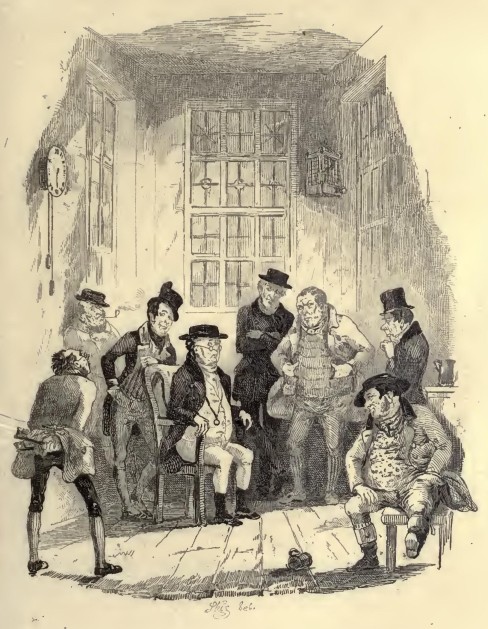

Mr. Pickwick complied with the invitation, and sat himself down; when Mr. Weller, who stationed himself at the back of the chair, whispered that the sitting was merely another term for undergoing an inspection by the different turnkeys, in order that they might know prisoners from visitors.
‘Well, Sam,’ said Mr. Pickwick, ‘then I wish the artists would come. This is rather a public place.’
‘They von’t be long, Sir, I des-say,’ replied Sam. ‘There’s a Dutch clock, sir.’
‘So I see,’ observed Mr. Pickwick.
‘And a bird-cage, sir,’ says Sam. ‘Veels vithin veels, a prison in a prison. Ain’t it, Sir?’
As Mr. Weller made this philosophical remark, Mr. Pickwick was aware that his sitting had commenced. The stout turnkey having been relieved from the lock, sat down, and looked at him carelessly, from time to time, while a long thin man who had relieved him, thrust his hands beneath his coat tails, and planting himself opposite, took a good long view of him. A third rather surly-looking gentleman, who had apparently been disturbed at his tea, for he was disposing of the last remnant of a crust and butter when he came in, stationed himself close to Mr. Pickwick; and, resting his hands on his hips, inspected him narrowly; while two others mixed with the group, and studied his features with most intent and thoughtful faces. Mr. Pickwick winced a good deal under the operation, and appeared to sit very uneasily in his chair; but he made no remark to anybody while it was being performed, not even to Sam, who reclined upon the back of the chair, reflecting, partly on the situation of his master, and partly on the great satisfaction it would have afforded him to make a fierce assault upon all the turnkeys there assembled, one after the other, if it were lawful and peaceable so to do.
At length the likeness was completed, and Mr. Pickwick was informed that he might now proceed into the prison.
‘Where am I to sleep to-night?’ inquired Mr. Pickwick.
‘Why, I don’t rightly know about to-night,’ replied the stout turnkey. ‘You’ll be chummed on somebody to-morrow, and then you’ll be all snug and comfortable. The first night’s generally rather unsettled, but you’ll be set all squares to-morrow.’
After some discussion, it was discovered that one of the turnkeys had a bed to let, which Mr. Pickwick could have for that night. He gladly agreed to hire it.
‘If you’ll come with me, I’ll show it you at once,’ said the man. ‘It ain’t a large ‘un; but it’s an out-and-outer to sleep in. This way, sir.’
They passed through the inner gate, and descended a short flight of steps. The key was turned after them; and Mr. Pickwick found himself, for the first time in his life, within the walls of a debtors’ prison.
CHAPTER XLI. WHAT BEFELL MR. PICKWICK WHEN HE GOT INTO THE FLEET; WHAT PRISONERS HE SAW THERE, AND HOW HE PASSED THE NIGHT
Mr. Tom Roker, the gentleman who had accompanied Mr. Pickwick into the prison, turned sharp round to the right when he got to the bottom of the little flight of steps, and led the way, through an iron gate which stood open, and up another short flight of steps, into a long narrow gallery, dirty and low, paved with stone, and very dimly lighted by a window at each remote end.
‘This,’ said the gentleman, thrusting his hands into his pockets, and looking carelessly over his shoulder to Mr. Pickwick—‘this here is the hall flight.’
‘Oh,’ replied Mr. Pickwick, looking down a dark and filthy staircase, which appeared to lead to a range of damp and gloomy stone vaults, beneath the ground, ‘and those, I suppose, are the little cellars where the prisoners keep their small quantities of coals. Unpleasant places to have to go down to; but very convenient, I dare say.’
‘Yes, I shouldn’t wonder if they was convenient,’ replied the gentleman, ‘seeing that a few people live there, pretty snug. That’s the Fair, that is.’
‘My friend,’ said Mr. Pickwick, ‘you don’t really mean to say that human beings live down in those wretched dungeons?’
‘Don’t I?’ replied Mr. Roker, with indignant astonishment; ‘why shouldn’t I?’
‘Live!—live down there!’ exclaimed Mr. Pickwick.
‘Live down there! Yes, and die down there, too, very often!’ replied Mr. Roker; ‘and what of that? Who’s got to say anything agin it? Live down there! Yes, and a wery good place it is to live in, ain’t it?’
As Roker turned somewhat fiercely upon Mr. Pickwick in saying this, and moreover muttered in an excited fashion certain unpleasant invocations concerning his own eyes, limbs, and circulating fluids, the latter gentleman deemed it advisable to pursue the discourse no further. Mr. Roker then proceeded to mount another staircase, as dirty as that which led to the place which has just been the subject of discussion, in which ascent he was closely followed by Mr. Pickwick and Sam.
‘There,’ said Mr. Roker, pausing for breath when they reached another gallery of the same dimensions as the one below, ‘this is the coffee-room flight; the one above’s the third, and the one above that’s the top; and the room where you’re a-going to sleep to-night is the warden’s room, and it’s this way—come on.’ Having said all this in a breath, Mr. Roker mounted another flight of stairs with Mr. Pickwick and Sam Weller following at his heels.
These staircases received light from sundry windows placed at some little distance above the floor, and looking into a gravelled area bounded by a high brick wall, with iron chevaux-de-frise at the top. This area, it appeared from Mr. Roker’s statement, was the racket-ground; and it further appeared, on the testimony of the same gentleman, that there was a smaller area in that portion of the prison which was nearest Farringdon Street, denominated and called ‘the Painted Ground,’ from the fact of its walls having once displayed the semblance of various men-of-war in full sail, and other artistical effects achieved in bygone times by some imprisoned draughtsman in his leisure hours.
Having communicated this piece of information, apparently more for the purpose of discharging his bosom of an important fact, than with any specific view of enlightening Mr. Pickwick, the guide, having at length reached another gallery, led the way into a small passage at the extreme end, opened a door, and disclosed an apartment of an appearance by no means inviting, containing eight or nine iron bedsteads.
‘There,’ said Mr. Roker, holding the door open, and looking triumphantly round at Mr. Pickwick, ‘there’s a room!’
Mr. Pickwick’s face, however, betokened such a very trifling portion of satisfaction at the appearance of his lodging, that Mr. Roker looked, for a reciprocity of feeling, into the countenance of Samuel Weller, who, until now, had observed a dignified silence.
‘There’s a room, young man,’ observed Mr. Roker.
‘I see it,’ replied Sam, with a placid nod of the head.
‘You wouldn’t think to find such a room as this in the Farringdon Hotel, would you?’ said Mr. Roker, with a complacent smile.
To this Mr. Weller replied with an easy and unstudied closing of one eye; which might be considered to mean, either that he would have thought it, or that he would not have thought it, or that he had never thought anything at all about it, as the observer’s imagination suggested. Having executed this feat, and reopened his eye, Mr. Weller proceeded to inquire which was the individual bedstead that Mr. Roker had so flatteringly described as an out-and-outer to sleep in.
‘That’s it,’ replied Mr. Roker, pointing to a very rusty one in a corner. ‘It would make any one go to sleep, that bedstead would, whether they wanted to or not.’
‘I should think,’ said Sam, eyeing the piece of furniture in question with a look of excessive disgust—‘I should think poppies was nothing to it.’
‘Nothing at all,’ said Mr. Roker.
‘And I s’pose,’ said Sam, with a sidelong glance at his master, as if to see whether there were any symptoms of his determination being shaken by what passed, ‘I s’pose the other gen’l’men as sleeps here are gen’l’men.’
‘Nothing but it,’ said Mr. Roker. ‘One of ‘em takes his twelve pints of ale a day, and never leaves off smoking even at his meals.’
‘He must be a first-rater,’ said Sam.
‘A1,’ replied Mr. Roker.
Nothing daunted, even by this intelligence, Mr. Pickwick smilingly announced his determination to test the powers of the narcotic bedstead for that night; and Mr. Roker, after informing him that he could retire to rest at whatever hour he thought proper, without any further notice or formality, walked off, leaving him standing with Sam in the gallery.
It was getting dark; that is to say, a few gas jets were kindled in this place which was never light, by way of compliment to the evening, which had set in outside. As it was rather warm, some of the tenants of the numerous little rooms which opened into the gallery on either hand, had set their doors ajar. Mr. Pickwick peeped into them as he passed along, with great curiosity and interest. Here, four or five great hulking fellows, just visible through a cloud of tobacco smoke, were engaged in noisy and riotous conversation over half-emptied pots of beer, or playing at all-fours with a very greasy pack of cards. In the adjoining room, some solitary tenant might be seen poring, by the light of a feeble tallow candle, over a bundle of soiled and tattered papers, yellow with dust and dropping to pieces from age, writing, for the hundredth time, some lengthened statement of his grievances, for the perusal of some great man whose eyes it would never reach, or whose heart it would never touch. In a third, a man, with his wife and a whole crowd of children, might be seen making up a scanty bed on the ground, or upon a few chairs, for the younger ones to pass the night in. And in a fourth, and a fifth, and a sixth, and a seventh, the noise, and the beer, and the tobacco smoke, and the cards, all came over again in greater force than before.
In the galleries themselves, and more especially on the stair-cases, there lingered a great number of people, who came there, some because their rooms were empty and lonesome, others because their rooms were full and hot; the greater part because they were restless and uncomfortable, and not possessed of the secret of exactly knowing what to do with themselves. There were many classes of people here, from the labouring man in his fustian jacket, to the broken-down spendthrift in his shawl dressing-gown, most appropriately out at elbows; but there was the same air about them all—a kind of listless, jail-bird, careless swagger, a vagabondish who’s-afraid sort of bearing, which is wholly indescribable in words, but which any man can understand in one moment if he wish, by setting foot in the nearest debtors’ prison, and looking at the very first group of people he sees there, with the same interest as Mr. Pickwick did.
‘It strikes me, Sam,’ said Mr. Pickwick, leaning over the iron rail at the stair-head, ‘it strikes me, Sam, that imprisonment for debt is scarcely any punishment at all.’
‘Think not, sir?’ inquired Mr. Weller.
‘You see how these fellows drink, and smoke, and roar,’ replied Mr. Pickwick. ‘It’s quite impossible that they can mind it much.’
‘Ah, that’s just the wery thing, Sir,’ rejoined Sam, ‘they don’t mind it; it’s a reg’lar holiday to them—all porter and skittles. It’s the t’other vuns as gets done over vith this sort o’ thing; them down-hearted fellers as can’t svig avay at the beer, nor play at skittles neither; them as vould pay if they could, and gets low by being boxed up. I’ll tell you wot it is, sir; them as is always a-idlin’ in public-houses it don’t damage at all, and them as is alvays a-workin’ wen they can, it damages too much. “It’s unekal,” as my father used to say wen his grog worn’t made half-and-half: “it’s unekal, and that’s the fault on it.”’
‘I think you’re right, Sam,’ said Mr. Pickwick, after a few moments’ reflection, ‘quite right.’
‘P’raps, now and then, there’s some honest people as likes it,’ observed Mr. Weller, in a ruminative tone, ‘but I never heerd o’ one as I can call to mind, ‘cept the little dirty-faced man in the brown coat; and that was force of habit.’
‘And who was he?’ inquired Mr. Pickwick.
‘Wy, that’s just the wery point as nobody never know’d,’ replied Sam.
‘But what did he do?’
‘Wy, he did wot many men as has been much better know’d has done in their time, Sir,’ replied Sam, ‘he run a match agin the constable, and vun it.’
‘In other words, I suppose,’ said Mr. Pickwick, ‘he got into debt.’
‘Just that, Sir,’ replied Sam, ‘and in course o’ time he come here in consekens. It warn’t much—execution for nine pound nothin’, multiplied by five for costs; but hows’ever here he stopped for seventeen year. If he got any wrinkles in his face, they were stopped up vith the dirt, for both the dirty face and the brown coat wos just the same at the end o’ that time as they wos at the beginnin’. He wos a wery peaceful, inoffendin’ little creetur, and wos alvays a-bustlin’ about for somebody, or playin’ rackets and never vinnin’; till at last the turnkeys they got quite fond on him, and he wos in the lodge ev’ry night, a-chattering vith ‘em, and tellin’ stories, and all that ‘ere. Vun night he wos in there as usual, along vith a wery old friend of his, as wos on the lock, ven he says all of a sudden, “I ain’t seen the market outside, Bill,” he says (Fleet Market wos there at that time)—“I ain’t seen the market outside, Bill,” he says, “for seventeen year.” “I know you ain’t,” says the turnkey, smoking his pipe. “I should like to see it for a minit, Bill,” he says. “Wery probable,” says the turnkey, smoking his pipe wery fierce, and making believe he warn’t up to wot the little man wanted. “Bill,” says the little man, more abrupt than afore, “I’ve got the fancy in my head. Let me see the public streets once more afore I die; and if I ain’t struck with apoplexy, I’ll be back in five minits by the clock.” “And wot ‘ud become o’ me if you wos struck with apoplexy?” said the turnkey. “Wy,” says the little creetur, “whoever found me, ‘ud bring me home, for I’ve got my card in my pocket, Bill,” he says, “No. 20, Coffee-room Flight”: and that wos true, sure enough, for wen he wanted to make the acquaintance of any new-comer, he used to pull out a little limp card vith them words on it and nothin’ else; in consideration of vich, he vos alvays called Number Tventy. The turnkey takes a fixed look at him, and at last he says in a solemn manner, “Tventy,” he says, “I’ll trust you; you Won’t get your old friend into trouble.” “No, my boy; I hope I’ve somethin’ better behind here,” says the little man; and as he said it he hit his little vesket wery hard, and then a tear started out o’ each eye, which wos wery extraordinary, for it wos supposed as water never touched his face. He shook the turnkey by the hand; out he vent—’
‘And never came back again,’ said Mr. Pickwick.
‘Wrong for vunce, sir,’ replied Mr. Weller, ‘for back he come, two minits afore the time, a-bilin’ with rage, sayin’ how he’d been nearly run over by a hackney-coach that he warn’t used to it; and he was blowed if he wouldn’t write to the lord mayor. They got him pacified at last; and for five years arter that, he never even so much as peeped out o’ the lodge gate.’
‘At the expiration of that time he died, I suppose,’ said Mr. Pickwick.
‘No, he didn’t, Sir,’ replied Sam. ‘He got a curiosity to go and taste the beer at a new public-house over the way, and it wos such a wery nice parlour, that he took it into his head to go there every night, which he did for a long time, always comin’ back reg’lar about a quarter of an hour afore the gate shut, which was all wery snug and comfortable. At last he began to get so precious jolly, that he used to forget how the time vent, or care nothin’ at all about it, and he went on gettin’ later and later, till vun night his old friend wos just a-shuttin’ the gate—had turned the key in fact—wen he come up. “Hold hard, Bill,” he says. “Wot, ain’t you come home yet, Tventy?” says the turnkey, “I thought you wos in, long ago.” “No, I wasn’t,” says the little man, with a smile. “Well, then, I’ll tell you wot it is, my friend,” says the turnkey, openin’ the gate wery slow and sulky, “it’s my ‘pinion as you’ve got into bad company o’ late, which I’m wery sorry to see. Now, I don’t wish to do nothing harsh,” he says, “but if you can’t confine yourself to steady circles, and find your vay back at reg’lar hours, as sure as you’re a-standin’ there, I’ll shut you out altogether!” The little man was seized vith a wiolent fit o’ tremblin’, and never vent outside the prison walls artervards!’
As Sam concluded, Mr. Pickwick slowly retraced his steps downstairs. After a few thoughtful turns in the Painted Ground, which, as it was now dark, was nearly deserted, he intimated to Mr. Weller that he thought it high time for him to withdraw for the night; requesting him to seek a bed in some adjacent public-house, and return early in the morning, to make arrangements for the removal of his master’s wardrobe from the George and Vulture. This request Mr. Samuel Weller prepared to obey, with as good a grace as he could assume, but with a very considerable show of reluctance nevertheless. He even went so far as to essay sundry ineffectual hints regarding the expediency of stretching himself on the gravel for that night; but finding Mr. Pickwick obstinately deaf to any such suggestions, finally withdrew.
There is no disguising the fact that Mr. Pickwick felt very low-spirited and uncomfortable—not for lack of society, for the prison was very full, and a bottle of wine would at once have purchased the utmost good-fellowship of a few choice spirits, without any more formal ceremony of introduction; but he was alone in the coarse, vulgar crowd, and felt the depression of spirits and sinking of heart, naturally consequent on the reflection that he was cooped and caged up, without a prospect of liberation. As to the idea of releasing himself by ministering to the sharpness of Dodson & Fogg, it never for an instant entered his thoughts.
In this frame of mind he turned again into the coffee-room gallery, and walked slowly to and fro. The place was intolerably dirty, and the smell of tobacco smoke perfectly suffocating. There was a perpetual slamming and banging of doors as the people went in and out; and the noise of their voices and footsteps echoed and re-echoed through the passages constantly. A young woman, with a child in her arms, who seemed scarcely able to crawl, from emaciation and misery, was walking up and down the passage in conversation with her husband, who had no other place to see her in. As they passed Mr. Pickwick, he could hear the female sob bitterly; and once she burst into such a passion of grief, that she was compelled to lean against the wall for support, while the man took the child in his arms, and tried to soothe her.
Mr. Pickwick’s heart was really too full to bear it, and he went upstairs to bed.
Now, although the warder’s room was a very uncomfortable one (being, in every point of decoration and convenience, several hundred degrees inferior to the common infirmary of a county jail), it had at present the merit of being wholly deserted save by Mr. Pickwick himself. So, he sat down at the foot of his little iron bedstead, and began to wonder how much a year the warder made out of the dirty room. Having satisfied himself, by mathematical calculation, that the apartment was about equal in annual value to the freehold of a small street in the suburbs of London, he took to wondering what possible temptation could have induced a dingy-looking fly that was crawling over his pantaloons, to come into a close prison, when he had the choice of so many airy situations—a course of meditation which led him to the irresistible conclusion that the insect was insane. After settling this point, he began to be conscious that he was getting sleepy; whereupon he took his nightcap out of the pocket in which he had had the precaution to stow it in the morning, and, leisurely undressing himself, got into bed and fell asleep.
‘Bravo! Heel over toe—cut and shuffle—pay away at it, Zephyr! I’m smothered if the opera house isn’t your proper hemisphere. Keep it up! Hooray!’ These expressions, delivered in a most boisterous tone, and accompanied with loud peals of laughter, roused Mr. Pickwick from one of those sound slumbers which, lasting in reality some half-hour, seem to the sleeper to have been protracted for three weeks or a month.
The voice had no sooner ceased than the room was shaken with such violence that the windows rattled in their frames, and the bedsteads trembled again. Mr. Pickwick started up, and remained for some minutes fixed in mute astonishment at the scene before him.
- The Posthumous Papers Of The Pickwick Club - Chapter Xlii. Illustrative, Like The Preceding One, Of The Old Proverb, That Adversity Brings A Man Acquainted With Strange Bedfellows— Likewise Containing Mr. Pickwick’s Extraordinary And Startling Announcement To Mr. Samuel Weller→
- The Posthumous Papers Of The Pickwick Club - Chapter Xxxviii. How Mr. Winkle, When He Stepped Out Of The Frying-pan, Walked Gently And Comfortably Into The Fire←