
At a much earlier hour next morning than his usual time of rising, Mr. Pickwick walked downstairs completely dressed, and rang the bell.
‘Sam,’ said Mr. Pickwick, when Mr. Weller appeared in reply to the summons, ‘shut the door.’
Mr. Weller did so.
‘There was an unfortunate occurrence here, last night, Sam,’ said Mr. Pickwick, ‘which gave Mr. Winkle some cause to apprehend violence from Mr. Dowler.’
‘So I’ve heerd from the old lady downstairs, Sir,’ replied Sam.
‘And I’m sorry to say, Sam,’ continued Mr. Pickwick, with a most perplexed countenance, ‘that in dread of this violence, Mr. Winkle has gone away.’
‘Gone avay!’ said Sam.
‘Left the house early this morning, without the slightest previous communication with me,’ replied Mr. Pickwick. ‘And is gone, I know not where.’
‘He should ha’ stopped and fought it out, Sir,’ replied Sam contemptuously. ‘It wouldn’t take much to settle that ‘ere Dowler, Sir.’
‘Well, Sam,’ said Mr. Pickwick, ‘I may have my doubts of his great bravery and determination also. But however that may be, Mr. Winkle is gone. He must be found, Sam. Found and brought back to me.’
And s’pose he won’t come back, Sir?’ said Sam.
‘He must be made, Sam,’ said Mr. Pickwick.
‘Who’s to do it, Sir?’ inquired Sam, with a smile.
‘You,’ replied Mr. Pickwick.
‘Wery good, Sir.’
With these words Mr. Weller left the room, and immediately afterwards was heard to shut the street door. In two hours’ time he returned with so much coolness as if he had been despatched on the most ordinary message possible, and brought the information that an individual, in every respect answering Mr. Winkle’s description, had gone over to Bristol that morning, by the branch coach from the Royal Hotel.
‘Sam,’ said Mr. Pickwick, grasping his hand, ‘you’re a capital fellow; an invaluable fellow. You must follow him, Sam.’
‘Cert’nly, Sir,’ replied Mr. Weller.
‘The instant you discover him, write to me immediately, Sam,’ said Mr. Pickwick. ‘If he attempts to run away from you, knock him down, or lock him up. You have my full authority, Sam.’
‘I’ll be wery careful, sir,’ rejoined Sam.
‘You’ll tell him,’ said Mr. Pickwick, ‘that I am highly excited, highly displeased, and naturally indignant, at the very extraordinary course he has thought proper to pursue.’
‘I will, Sir,’ replied Sam.
‘You’ll tell him,’ said Mr. Pickwick, ‘that if he does not come back to this very house, with you, he will come back with me, for I will come and fetch him.’
‘I’ll mention that ‘ere, Sir,’ rejoined Sam.
‘You think you can find him, Sam?’ said Mr. Pickwick, looking earnestly in his face.
‘Oh, I’ll find him if he’s anyvere,’ rejoined Sam, with great confidence.
‘Very well,’ said Mr. Pickwick. ‘Then the sooner you go the better.’
With these instructions, Mr. Pickwick placed a sum of money in the hands of his faithful servitor, and ordered him to start for Bristol immediately, in pursuit of the fugitive.
Sam put a few necessaries in a carpet-bag, and was ready for starting. He stopped when he had got to the end of the passage, and walking quietly back, thrust his head in at the parlour door.
‘Sir,’ whispered Sam.
‘Well, Sam,’ said Mr. Pickwick.
‘I fully understands my instructions, do I, Sir?’ inquired Sam.
‘I hope so,’ said Mr. Pickwick.
‘It’s reg’larly understood about the knockin’ down, is it, Sir?’ inquired Sam.
‘Perfectly,’ replied Pickwick. ‘Thoroughly. Do what you think necessary. You have my orders.’
Sam gave a nod of intelligence, and withdrawing his head from the door, set forth on his pilgrimage with a light heart.
CHAPTER XXXVIII. HOW MR. WINKLE, WHEN HE STEPPED OUT OF THE FRYING-PAN, WALKED GENTLY AND COMFORTABLY INTO THE FIRE
The ill-starred gentleman who had been the unfortunate cause of the unusual noise and disturbance which alarmed the inhabitants of the Royal Crescent in manner and form already described, after passing a night of great confusion and anxiety, left the roof beneath which his friends still slumbered, bound he knew not whither. The excellent and considerate feelings which prompted Mr. Winkle to take this step can never be too highly appreciated or too warmly extolled. ‘If,’ reasoned Mr. Winkle with himself—‘if this Dowler attempts (as I have no doubt he will) to carry into execution his threat of personal violence against myself, it will be incumbent on me to call him out. He has a wife; that wife is attached to, and dependent on him. Heavens! If I should kill him in the blindness of my wrath, what would be my feelings ever afterwards!’ This painful consideration operated so powerfully on the feelings of the humane young man, as to cause his knees to knock together, and his countenance to exhibit alarming manifestations of inward emotion. Impelled by such reflections, he grasped his carpet-bag, and creeping stealthily downstairs, shut the detestable street door with as little noise as possible, and walked off. Bending his steps towards the Royal Hotel, he found a coach on the point of starting for Bristol, and, thinking Bristol as good a place for his purpose as any other he could go to, he mounted the box, and reached his place of destination in such time as the pair of horses, who went the whole stage and back again, twice a day or more, could be reasonably supposed to arrive there.
He took up his quarters at the Bush, and designing to postpone any communication by letter with Mr. Pickwick until it was probable that Mr. Dowler’s wrath might have in some degree evaporated, walked forth to view the city, which struck him as being a shade more dirty than any place he had ever seen. Having inspected the docks and shipping, and viewed the cathedral, he inquired his way to Clifton, and being directed thither, took the route which was pointed out to him. But as the pavements of Bristol are not the widest or cleanest upon earth, so its streets are not altogether the straightest or least intricate; and Mr. Winkle, being greatly puzzled by their manifold windings and twistings, looked about him for a decent shop in which he could apply afresh for counsel and instruction.
His eye fell upon a newly-painted tenement which had been recently converted into something between a shop and a private house, and which a red lamp, projecting over the fanlight of the street door, would have sufficiently announced as the residence of a medical practitioner, even if the word ‘Surgery’ had not been inscribed in golden characters on a wainscot ground, above the window of what, in times bygone, had been the front parlour. Thinking this an eligible place wherein to make his inquiries, Mr. Winkle stepped into the little shop where the gilt-labelled drawers and bottles were; and finding nobody there, knocked with a half-crown on the counter, to attract the attention of anybody who might happen to be in the back parlour, which he judged to be the innermost and peculiar sanctum of the establishment, from the repetition of the word surgery on the door—painted in white letters this time, by way of taking off the monotony.
At the first knock, a sound, as of persons fencing with fire-irons, which had until now been very audible, suddenly ceased; at the second, a studious-looking young gentleman in green spectacles, with a very large book in his hand, glided quietly into the shop, and stepping behind the counter, requested to know the visitor’s pleasure.
‘I am sorry to trouble you, Sir,’ said Mr. Winkle, ‘but will you have the goodness to direct me to—’
‘Ha! ha! ha!’ roared the studious young gentleman, throwing the large book up into the air, and catching it with great dexterity at the very moment when it threatened to smash to atoms all the bottles on the counter. ‘Here’s a start!’
There was, without doubt; for Mr. Winkle was so very much astonished at the extraordinary behaviour of the medical gentleman, that he involuntarily retreated towards the door, and looked very much disturbed at his strange reception.
‘What, don’t you know me?’ said the medical gentleman.
Mr. Winkle murmured, in reply, that he had not that pleasure.
‘Why, then,’ said the medical gentleman, ‘there are hopes for me yet; I may attend half the old women in Bristol, if I’ve decent luck. Get out, you mouldy old villain, get out!’ With this adjuration, which was addressed to the large book, the medical gentleman kicked the volume with remarkable agility to the farther end of the shop, and, pulling off his green spectacles, grinned the identical grin of Robert Sawyer, Esquire, formerly of Guy’s Hospital in the Borough, with a private residence in Lant Street.
‘You don’t mean to say you weren’t down upon me?’ said Mr. Bob Sawyer, shaking Mr. Winkle’s hand with friendly warmth.
‘Upon my word I was not,’ replied Mr. Winkle, returning his pressure.
‘I wonder you didn’t see the name,’ said Bob Sawyer, calling his friend’s attention to the outer door, on which, in the same white paint, were traced the words ‘Sawyer, late Nockemorf.’
‘It never caught my eye,’ returned Mr. Winkle.
‘Lord, if I had known who you were, I should have rushed out, and caught you in my arms,’ said Bob Sawyer; ‘but upon my life, I thought you were the King’s-taxes.’
‘No!’ said Mr. Winkle.
‘I did, indeed,’ responded Bob Sawyer, ‘and I was just going to say that I wasn’t at home, but if you’d leave a message I’d be sure to give it to myself; for he don’t know me; no more does the Lighting and Paving. I think the Church-rates guesses who I am, and I know the Water-works does, because I drew a tooth of his when I first came down here. But come in, come in!’ Chattering in this way, Mr. Bob Sawyer pushed Mr. Winkle into the back room, where, amusing himself by boring little circular caverns in the chimney-piece with a red-hot poker, sat no less a person than Mr. Benjamin Allen.
‘Well!’ said Mr. Winkle. ‘This is indeed a pleasure I did not expect. What a very nice place you have here!’
‘Pretty well, pretty well,’ replied Bob Sawyer. ‘I passed, soon after that precious party, and my friends came down with the needful for this business; so I put on a black suit of clothes, and a pair of spectacles, and came here to look as solemn as I could.’
‘And a very snug little business you have, no doubt?’ said Mr. Winkle knowingly.
‘Very,’ replied Bob Sawyer. ‘So snug, that at the end of a few years you might put all the profits in a wine-glass, and cover ‘em over with a gooseberry leaf.’
You cannot surely mean that?’ said Mr. Winkle. ‘The stock itself—’
Dummies, my dear boy,’ said Bob Sawyer; ‘half the drawers have nothing in ‘em, and the other half don’t open.’
‘Nonsense!’ said Mr. Winkle.
‘Fact—honour!’ returned Bob Sawyer, stepping out into the shop, and demonstrating the veracity of the assertion by divers hard pulls at the little gilt knobs on the counterfeit drawers. ‘Hardly anything real in the shop but the leeches, and they are second-hand.’
‘I shouldn’t have thought it!’ exclaimed Mr. Winkle, much surprised.
‘I hope not,’ replied Bob Sawyer, ‘else where’s the use of appearances, eh? But what will you take? Do as we do? That’s right. Ben, my fine fellow, put your hand into the cupboard, and bring out the patent digester.’
Mr. Benjamin Allen smiled his readiness, and produced from the closet at his elbow a black bottle half full of brandy.
‘You don’t take water, of course?’ said Bob Sawyer.
‘Thank you,’ replied Mr. Winkle. ‘It’s rather early. I should like to qualify it, if you have no objection.’
‘None in the least, if you can reconcile it to your conscience,’ replied Bob Sawyer, tossing off, as he spoke, a glass of the liquor with great relish. ‘Ben, the pipkin!’
Mr. Benjamin Allen drew forth, from the same hiding-place, a small brass pipkin, which Bob Sawyer observed he prided himself upon, particularly because it looked so business-like. The water in the professional pipkin having been made to boil, in course of time, by various little shovelfuls of coal, which Mr. Bob Sawyer took out of a practicable window-seat, labelled ‘Soda Water,’ Mr. Winkle adulterated his brandy; and the conversation was becoming general, when it was interrupted by the entrance into the shop of a boy, in a sober gray livery and a gold-laced hat, with a small covered basket under his arm, whom Mr. Bob Sawyer immediately hailed with, ‘Tom, you vagabond, come here.’
The boy presented himself accordingly.
‘You’ve been stopping to “over” all the posts in Bristol, you idle young scamp!’ said Mr. Bob Sawyer.
‘No, sir, I haven’t,’ replied the boy.
‘You had better not!’ said Mr. Bob Sawyer, with a threatening aspect. ‘Who do you suppose will ever employ a professional man, when they see his boy playing at marbles in the gutter, or flying the garter in the horse-road? Have you no feeling for your profession, you groveller? Did you leave all the medicine?’
Yes, Sir.’
‘The powders for the child, at the large house with the new family, and the pills to be taken four times a day at the ill-tempered old gentleman’s with the gouty leg?’
‘Yes, sir.’
‘Then shut the door, and mind the shop.’
‘Come,’ said Mr. Winkle, as the boy retired, ‘things are not quite so bad as you would have me believe, either. There is some medicine to be sent out.’
Mr. Bob Sawyer peeped into the shop to see that no stranger was within hearing, and leaning forward to Mr. Winkle, said, in a low tone—
‘He leaves it all at the wrong houses.’
Mr. Winkle looked perplexed, and Bob Sawyer and his friend laughed.
‘Don’t you see?’ said Bob. ‘He goes up to a house, rings the area bell, pokes a packet of medicine without a direction into the servant’s hand, and walks off. Servant takes it into the dining-parlour; master opens it, and reads the label: “Draught to be taken at bedtime—pills as before—lotion as usual—the powder. From Sawyer’s, late Nockemorf’s. Physicians’ prescriptions carefully prepared,” and all the rest of it. Shows it to his wife—she reads the label; it goes down to the servants—they read the label. Next day, boy calls: “Very sorry—his mistake—immense business—great many parcels to deliver—Mr. Sawyer’s compliments—late Nockemorf.” The name gets known, and that’s the thing, my boy, in the medical way. Bless your heart, old fellow, it’s better than all the advertising in the world. We have got one four-ounce bottle that’s been to half the houses in Bristol, and hasn’t done yet.’
‘Dear me, I see,’ observed Mr. Winkle; ‘what an excellent plan!’
‘Oh, Ben and I have hit upon a dozen such,’ replied Bob Sawyer, with great glee. ‘The lamplighter has eighteenpence a week to pull the night-bell for ten minutes every time he comes round; and my boy always rushes into the church just before the psalms, when the people have got nothing to do but look about ‘em, and calls me out, with horror and dismay depicted on his countenance. “Bless my soul,” everybody says, “somebody taken suddenly ill! Sawyer, late Nockemorf, sent for. What a business that young man has!”’
At the termination of this disclosure of some of the mysteries of medicine, Mr. Bob Sawyer and his friend, Ben Allen, threw themselves back in their respective chairs, and laughed boisterously. When they had enjoyed the joke to their heart’s content, the discourse changed to topics in which Mr. Winkle was more immediately interested.
We think we have hinted elsewhere, that Mr. Benjamin Allen had a way of becoming sentimental after brandy. The case is not a peculiar one, as we ourself can testify, having, on a few occasions, had to deal with patients who have been afflicted in a similar manner. At this precise period of his existence, Mr. Benjamin Allen had perhaps a greater predisposition to maudlinism than he had ever known before; the cause of which malady was briefly this. He had been staying nearly three weeks with Mr. Bob Sawyer; Mr. Bob Sawyer was not remarkable for temperance, nor was Mr. Benjamin Allen for the ownership of a very strong head; the consequence was that, during the whole space of time just mentioned, Mr. Benjamin Allen had been wavering between intoxication partial, and intoxication complete.
‘My dear friend,’ said Mr. Ben Allen, taking advantage of Mr. Bob Sawyer’s temporary absence behind the counter, whither he had retired to dispense some of the second-hand leeches, previously referred to; ‘my dear friend, I am very miserable.’
Mr. Winkle professed his heartfelt regret to hear it, and begged to know whether he could do anything to alleviate the sorrows of the suffering student.
‘Nothing, my dear boy, nothing,’ said Ben. ‘You recollect Arabella, Winkle? My sister Arabella—a little girl, Winkle, with black eyes—when we were down at Wardle’s? I don’t know whether you happened to notice her—a nice little girl, Winkle. Perhaps my features may recall her countenance to your recollection?’
Mr. Winkle required nothing to recall the charming Arabella to his mind; and it was rather fortunate he did not, for the features of her brother Benjamin would unquestionably have proved but an indifferent refresher to his memory. He answered, with as much calmness as he could assume, that he perfectly remembered the young lady referred to, and sincerely trusted she was in good health.
‘Our friend Bob is a delightful fellow, Winkle,’ was the only reply of Mr. Ben Allen.
‘Very,’ said Mr. Winkle, not much relishing this close connection of the two names.
‘I designed ‘em for each other; they were made for each other, sent into the world for each other, born for each other, Winkle,’ said Mr. Ben Allen, setting down his glass with emphasis. ‘There’s a special destiny in the matter, my dear sir; there’s only five years’ difference between ‘em, and both their birthdays are in August.’
Mr. Winkle was too anxious to hear what was to follow to express much wonderment at this extraordinary coincidence, marvellous as it was; so Mr. Ben Allen, after a tear or two, went on to say that, notwithstanding all his esteem and respect and veneration for his friend, Arabella had unaccountably and undutifully evinced the most determined antipathy to his person.
‘And I think,’ said Mr. Ben Allen, in conclusion. ‘I think there’s a prior attachment.’
‘Have you any idea who the object of it might be?’ asked Mr. Winkle, with great trepidation.
Mr. Ben Allen seized the poker, flourished it in a warlike manner above his head, inflicted a savage blow on an imaginary skull, and wound up by saying, in a very expressive manner, that he only wished he could guess; that was all.
‘I’d show him what I thought of him,’ said Mr. Ben Allen. And round went the poker again, more fiercely than before.
All this was, of course, very soothing to the feelings of Mr. Winkle, who remained silent for a few minutes; but at length mustered up resolution to inquire whether Miss Allen was in Kent.
‘No, no,’ said Mr. Ben Allen, laying aside the poker, and looking very cunning; ‘I didn’t think Wardle’s exactly the place for a headstrong girl; so, as I am her natural protector and guardian, our parents being dead, I have brought her down into this part of the country to spend a few months at an old aunt’s, in a nice, dull, close place. I think that will cure her, my boy. If it doesn’t, I’ll take her abroad for a little while, and see what that’ll do.’
‘Oh, the aunt’s is in Bristol, is it?’ faltered Mr. Winkle.
‘No, no, not in Bristol,’ replied Mr. Ben Allen, jerking his thumb over his right shoulder; ‘over that way—down there. But, hush, here’s Bob. Not a word, my dear friend, not a word.’
Short as this conversation was, it roused in Mr. Winkle the highest degree of excitement and anxiety. The suspected prior attachment rankled in his heart. Could he be the object of it? Could it be for him that the fair Arabella had looked scornfully on the sprightly Bob Sawyer, or had he a successful rival? He determined to see her, cost what it might; but here an insurmountable objection presented itself, for whether the explanatory ‘over that way,’ and ‘down there,’ of Mr. Ben Allen, meant three miles off, or thirty, or three hundred, he could in no wise guess.
But he had no opportunity of pondering over his love just then, for Bob Sawyer’s return was the immediate precursor of the arrival of a meat-pie from the baker’s, of which that gentleman insisted on his staying to partake. The cloth was laid by an occasional charwoman, who officiated in the capacity of Mr. Bob Sawyer’s housekeeper; and a third knife and fork having been borrowed from the mother of the boy in the gray livery (for Mr. Sawyer’s domestic arrangements were as yet conducted on a limited scale), they sat down to dinner; the beer being served up, as Mr. Sawyer remarked, ‘in its native pewter.’
After dinner, Mr. Bob Sawyer ordered in the largest mortar in the shop, and proceeded to brew a reeking jorum of rum-punch therein, stirring up and amalgamating the materials with a pestle in a very creditable and apothecary-like manner. Mr. Sawyer, being a bachelor, had only one tumbler in the house, which was assigned to Mr. Winkle as a compliment to the visitor, Mr. Ben Allen being accommodated with a funnel with a cork in the narrow end, and Bob Sawyer contented himself with one of those wide-lipped crystal vessels inscribed with a variety of cabalistic characters, in which chemists are wont to measure out their liquid drugs in compounding prescriptions. These preliminaries adjusted, the punch was tasted, and pronounced excellent; and it having been arranged that Bob Sawyer and Ben Allen should be considered at liberty to fill twice to Mr. Winkle’s once, they started fair, with great satisfaction and good-fellowship.
There was no singing, because Mr. Bob Sawyer said it wouldn’t look professional; but to make amends for this deprivation there was so much talking and laughing that it might have been heard, and very likely was, at the end of the street. Which conversation materially lightened the hours and improved the mind of Mr. Bob Sawyer’s boy, who, instead of devoting the evening to his ordinary occupation of writing his name on the counter, and rubbing it out again, peeped through the glass door, and thus listened and looked on at the same time.
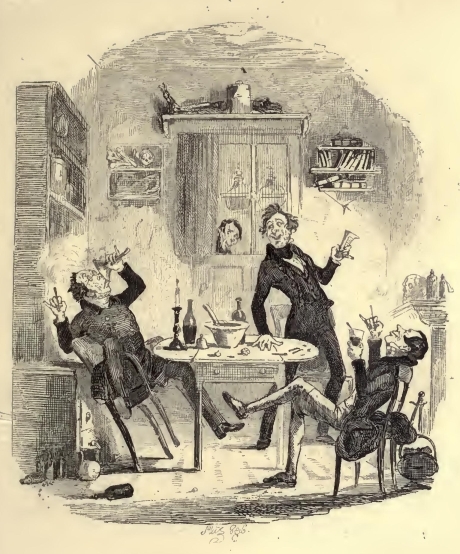

The mirth of Mr. Bob Sawyer was rapidly ripening into the furious, Mr. Ben Allen was fast relapsing into the sentimental, and the punch had well-nigh disappeared altogether, when the boy hastily running in, announced that a young woman had just come over, to say that Sawyer late Nockemorf was wanted directly, a couple of streets off. This broke up the party. Mr. Bob Sawyer, understanding the message, after some twenty repetitions, tied a wet cloth round his head to sober himself, and, having partially succeeded, put on his green spectacles and issued forth. Resisting all entreaties to stay till he came back, and finding it quite impossible to engage Mr. Ben Allen in any intelligible conversation on the subject nearest his heart, or indeed on any other, Mr. Winkle took his departure, and returned to the Bush.
The anxiety of his mind, and the numerous meditations which Arabella had awakened, prevented his share of the mortar of punch producing that effect upon him which it would have had under other circumstances. So, after taking a glass of soda-water and brandy at the bar, he turned into the coffee-room, dispirited rather than elevated by the occurrences of the evening.
Sitting in front of the fire, with his back towards him, was a tallish gentleman in a greatcoat: the only other occupant of the room. It was rather a cool evening for the season of the year, and the gentleman drew his chair aside to afford the new-comer a sight of the fire. What were Mr. Winkle’s feelings when, in doing so, he disclosed to view the face and figure of the vindictive and sanguinary Dowler!
Mr. Winkle’s first impulse was to give a violent pull at the nearest bell-handle, but that unfortunately happened to be immediately behind Mr. Dowler’s head. He had made one step towards it, before he checked himself. As he did so, Mr. Dowler very hastily drew back.
‘Mr. Winkle, Sir. Be calm. Don’t strike me. I won’t bear it. A blow! Never!’ said Mr. Dowler, looking meeker than Mr. Winkle had expected in a gentleman of his ferocity.
‘A blow, Sir?’ stammered Mr. Winkle.
‘A blow, Sir,’ replied Dowler. ‘Compose your feelings. Sit down. Hear me.’
‘Sir,’ said Mr. Winkle, trembling from head to foot, ‘before I consent to sit down beside, or opposite you, without the presence of a waiter, I must be secured by some further understanding. You used a threat against me last night, Sir, a dreadful threat, Sir.’ Here Mr. Winkle turned very pale indeed, and stopped short.
‘I did,’ said Dowler, with a countenance almost as white as Mr. Winkle’s. ‘Circumstances were suspicious. They have been explained. I respect your bravery. Your feeling is upright. Conscious innocence. There’s my hand. Grasp it.’
‘Really, Sir,’ said Mr. Winkle, hesitating whether to give his hand or not, and almost fearing that it was demanded in order that he might be taken at an advantage, ‘really, Sir, I—’
‘I know what you mean,’ interposed Dowler. ‘You feel aggrieved. Very natural. So should I. I was wrong. I beg your pardon. Be friendly. Forgive me.’ With this, Dowler fairly forced his hand upon Mr. Winkle, and shaking it with the utmost vehemence, declared he was a fellow of extreme spirit, and he had a higher opinion of him than ever.
‘Now,’ said Dowler, ‘sit down. Relate it all. How did you find me? When did you follow? Be frank. Tell me.’
‘It’s quite accidental,’ replied Mr. Winkle, greatly perplexed by the curious and unexpected nature of the interview. ‘Quite.’
‘Glad of it,’ said Dowler. ‘I woke this morning. I had forgotten my threat. I laughed at the accident. I felt friendly. I said so.’
‘To whom?’ inquired Mr. Winkle.
‘To Mrs. Dowler. “You made a vow,” said she. “I did,” said I. “It was a rash one,” said she. “It was,” said I. “I’ll apologise. Where is he?”’
‘Who?’ inquired Mr. Winkle.
‘You,’ replied Dowler. ‘I went downstairs. You were not to be found. Pickwick looked gloomy. Shook his head. Hoped no violence would be committed. I saw it all. You felt yourself insulted. You had gone, for a friend perhaps. Possibly for pistols. “High spirit,” said I. “I admire him.”’
Mr. Winkle coughed, and beginning to see how the land lay, assumed a look of importance.
‘I left a note for you,’ resumed Dowler. ‘I said I was sorry. So I was. Pressing business called me here. You were not satisfied. You followed. You required a verbal explanation. You were right. It’s all over now. My business is finished. I go back to-morrow. Join me.’
As Dowler progressed in his explanation, Mr. Winkle’s countenance grew more and more dignified. The mysterious nature of the commencement of their conversation was explained; Mr. Dowler had as great an objection to duelling as himself; in short, this blustering and awful personage was one of the most egregious cowards in existence, and interpreting Mr. Winkle’s absence through the medium of his own fears, had taken the same step as himself, and prudently retired until all excitement of feeling should have subsided.
As the real state of the case dawned upon Mr. Winkle’s mind, he looked very terrible, and said he was perfectly satisfied; but at the same time, said so with an air that left Mr. Dowler no alternative but to infer that if he had not been, something most horrible and destructive must inevitably have occurred. Mr. Dowler appeared to be impressed with a becoming sense of Mr. Winkle’s magnanimity and condescension; and the two belligerents parted for the night, with many protestations of eternal friendship.
About half-past twelve o’clock, when Mr. Winkle had been revelling some twenty minutes in the full luxury of his first sleep, he was suddenly awakened by a loud knocking at his chamber door, which, being repeated with increased vehemence, caused him to start up in bed, and inquire who was there, and what the matter was.
‘Please, Sir, here’s a young man which says he must see you directly,’ responded the voice of the chambermaid.
‘A young man!’ exclaimed Mr. Winkle.
‘No mistake about that ‘ere, Sir,’ replied another voice through the keyhole; ‘and if that wery same interestin’ young creetur ain’t let in vithout delay, it’s wery possible as his legs vill enter afore his countenance.’ The young man gave a gentle kick at one of the lower panels of the door, after he had given utterance to this hint, as if to add force and point to the remark.
‘Is that you, Sam?’ inquired Mr. Winkle, springing out of bed.
‘Quite unpossible to identify any gen’l’m’n vith any degree o’ mental satisfaction, vithout lookin’ at him, Sir,’ replied the voice dogmatically.
Mr. Winkle, not much doubting who the young man was, unlocked the door; which he had no sooner done than Mr. Samuel Weller entered with great precipitation, and carefully relocking it on the inside, deliberately put the key in his waistcoat pocket; and, after surveying Mr. Winkle from head to foot, said—
‘You’re a wery humorous young gen’l’m’n, you air, Sir!’
‘What do you mean by this conduct, Sam?’ inquired Mr. Winkle indignantly. ‘Get out, sir, this instant. What do you mean, Sir?’
‘What do I mean,’ retorted Sam; ‘come, Sir, this is rayther too rich, as the young lady said when she remonstrated with the pastry-cook, arter he’d sold her a pork pie as had got nothin’ but fat inside. What do I mean! Well, that ain’t a bad ‘un, that ain’t.’
‘Unlock that door, and leave this room immediately, Sir,’ said Mr. Winkle.
‘I shall leave this here room, sir, just precisely at the wery same moment as you leaves it,’ responded Sam, speaking in a forcible manner, and seating himself with perfect gravity. ‘If I find it necessary to carry you away, pick-a-back, o’ course I shall leave it the least bit o’ time possible afore you; but allow me to express a hope as you won’t reduce me to extremities; in saying wich, I merely quote wot the nobleman said to the fractious pennywinkle, ven he vouldn’t come out of his shell by means of a pin, and he conseqvently began to be afeered that he should be obliged to crack him in the parlour door.’ At the end of this address, which was unusually lengthy for him, Mr. Weller planted his hands on his knees, and looked full in Mr. Winkle’s face, with an expression of countenance which showed that he had not the remotest intention of being trifled with.
‘You’re a amiably-disposed young man, Sir, I don’t think,’ resumed Mr. Weller, in a tone of moral reproof, ‘to go inwolving our precious governor in all sorts o’ fanteegs, wen he’s made up his mind to go through everythink for principle. You’re far worse nor Dodson, Sir; and as for Fogg, I consider him a born angel to you!’ Mr. Weller having accompanied this last sentiment with an emphatic slap on each knee, folded his arms with a look of great disgust, and threw himself back in his chair, as if awaiting the criminal’s defence.
‘My good fellow,’ said Mr. Winkle, extending his hand—his teeth chattering all the time he spoke, for he had been standing, during the whole of Mr. Weller’s lecture, in his night-gear—‘my good fellow, I respect your attachment to my excellent friend, and I am very sorry indeed to have added to his causes for disquiet. There, Sam, there!’
‘Well,’ said Sam, rather sulkily, but giving the proffered hand a respectful shake at the same time—‘well, so you ought to be, and I am very glad to find you air; for, if I can help it, I won’t have him put upon by nobody, and that’s all about it.’
‘Certainly not, Sam,’ said Mr. Winkle. ‘There! Now go to bed, Sam, and we’ll talk further about this in the morning.’
‘I’m wery sorry,’ said Sam, ‘but I can’t go to bed.’
‘Not go to bed!’ repeated Mr. Winkle.
‘No,’ said Sam, shaking his head. ‘Can’t be done.’
‘You don’t mean to say you’re going back to-night, Sam?’ urged Mr. Winkle, greatly surprised.
‘Not unless you particklerly wish it,’ replied Sam; ‘but I mustn’t leave this here room. The governor’s orders wos peremptory.’
‘Nonsense, Sam,’ said Mr. Winkle, ‘I must stop here two or three days; and more than that, Sam, you must stop here too, to assist me in gaining an interview with a young lady—Miss Allen, Sam; you remember her—whom I must and will see before I leave Bristol.’
But in reply to each of these positions, Sam shook his head with great firmness, and energetically replied, ‘It can’t be done.’
After a great deal of argument and representation on the part of Mr. Winkle, however, and a full disclosure of what had passed in the interview with Dowler, Sam began to waver; and at length a compromise was effected, of which the following were the main and principal conditions:—
That Sam should retire, and leave Mr. Winkle in the undisturbed possession of his apartment, on the condition that he had permission to lock the door on the outside, and carry off the key; provided always, that in the event of an alarm of fire, or other dangerous contingency, the door should be instantly unlocked. That a letter should be written to Mr. Pickwick early next morning, and forwarded per Dowler, requesting his consent to Sam and Mr. Winkle’s remaining at Bristol, for the purpose and with the object already assigned, and begging an answer by the next coach—, if favourable, the aforesaid parties to remain accordingly, and if not, to return to Bath immediately on the receipt thereof. And, lastly, that Mr. Winkle should be understood as distinctly pledging himself not to resort to the window, fireplace, or other surreptitious mode of escape in the meanwhile. These stipulations having been concluded, Sam locked the door and departed.
He had nearly got downstairs, when he stopped, and drew the key from his pocket.
‘I quite forgot about the knockin’ down,’ said Sam, half turning back. ‘The governor distinctly said it was to be done. Amazin’ stupid o’ me, that ‘ere! Never mind,’ said Sam, brightening up, ‘it’s easily done to-morrow, anyvays.’
Apparently much consoled by this reflection, Mr. Weller once more deposited the key in his pocket, and descending the remainder of the stairs without any fresh visitations of conscience, was soon, in common with the other inmates of the house, buried in profound repose.
CHAPTER XXXIX. MR. SAMUEL WELLER, BEING INTRUSTED WITH A MISSION OF LOVE, PROCEEDS TO EXECUTE IT; WITH WHAT SUCCESS WILL HEREINAFTER APPEAR
During the whole of next day, Sam kept Mr. Winkle steadily in sight, fully determined not to take his eyes off him for one instant, until he should receive express instructions from the fountain-head. However disagreeable Sam’s very close watch and great vigilance were to Mr. Winkle, he thought it better to bear with them, than, by any act of violent opposition, to hazard being carried away by force, which Mr. Weller more than once strongly hinted was the line of conduct that a strict sense of duty prompted him to pursue. There is little reason to doubt that Sam would very speedily have quieted his scruples, by bearing Mr. Winkle back to Bath, bound hand and foot, had not Mr. Pickwick’s prompt attention to the note, which Dowler had undertaken to deliver, forestalled any such proceeding. In short, at eight o’clock in the evening, Mr. Pickwick himself walked into the coffee-room of the Bush Tavern, and told Sam with a smile, to his very great relief, that he had done quite right, and it was unnecessary for him to mount guard any longer.
‘I thought it better to come myself,’ said Mr. Pickwick, addressing Mr. Winkle, as Sam disencumbered him of his great-coat and travelling-shawl, ‘to ascertain, before I gave my consent to Sam’s employment in this matter, that you are quite in earnest and serious, with respect to this young lady.’
‘Serious, from my heart—from my soul!’ returned Mr. Winkle, with great energy.
‘Remember,’ said Mr. Pickwick, with beaming eyes, ‘we met her at our excellent and hospitable friend’s, Winkle. It would be an ill return to tamper lightly, and without due consideration, with this young lady’s affections. I’ll not allow that, sir. I’ll not allow it.’
‘I have no such intention, indeed,’ exclaimed Mr. Winkle warmly. ‘I have considered the matter well, for a long time, and I feel that my happiness is bound up in her.’
‘That’s wot we call tying it up in a small parcel, sir,’ interposed Mr. Weller, with an agreeable smile.
Mr. Winkle looked somewhat stern at this interruption, and Mr. Pickwick angrily requested his attendant not to jest with one of the best feelings of our nature; to which Sam replied, ‘That he wouldn’t, if he was aware on it; but there were so many on ‘em, that he hardly know’d which was the best ones wen he heerd ‘em mentioned.’
Mr. Winkle then recounted what had passed between himself and Mr. Ben Allen, relative to Arabella; stated that his object was to gain an interview with the young lady, and make a formal disclosure of his passion; and declared his conviction, founded on certain dark hints and mutterings of the aforesaid Ben, that, wherever she was at present immured, it was somewhere near the Downs. And this was his whole stock of knowledge or suspicion on the subject.
With this very slight clue to guide him, it was determined that Mr. Weller should start next morning on an expedition of discovery; it was also arranged that Mr. Pickwick and Mr. Winkle, who were less confident of their powers, should parade the town meanwhile, and accidentally drop in upon Mr. Bob Sawyer in the course of the day, in the hope of seeing or hearing something of the young lady’s whereabouts.
Accordingly, next morning, Sam Weller issued forth upon his quest, in no way daunted by the very discouraging prospect before him; and away he walked, up one street and down another—we were going to say, up one hill and down another, only it’s all uphill at Clifton—without meeting with anything or anybody that tended to throw the faintest light on the matter in hand. Many were the colloquies into which Sam entered with grooms who were airing horses on roads, and nursemaids who were airing children in lanes; but nothing could Sam elicit from either the first-mentioned or the last, which bore the slightest reference to the object of his artfully-prosecuted inquiries. There were a great many young ladies in a great many houses, the greater part whereof were shrewdly suspected by the male and female domestics to be deeply attached to somebody, or perfectly ready to become so, if opportunity afforded. But as none among these young ladies was Miss Arabella Allen, the information left Sam at exactly the old point of wisdom at which he had stood before.
Sam struggled across the Downs against a good high wind, wondering whether it was always necessary to hold your hat on with both hands in that part of the country, and came to a shady by-place, about which were sprinkled several little villas of quiet and secluded appearance. Outside a stable door at the bottom of a long back lane without a thoroughfare, a groom in undress was idling about, apparently persuading himself that he was doing something with a spade and a wheel-barrow. We may remark, in this place, that we have scarcely ever seen a groom near a stable, in his lazy moments, who has not been, to a greater or less extent, the victim of this singular delusion.
Sam thought he might as well talk to this groom as to any one else, especially as he was very tired with walking, and there was a good large stone just opposite the wheel-barrow; so he strolled down the lane, and, seating himself on the stone, opened a conversation with the ease and freedom for which he was remarkable.
‘Mornin’, old friend,’ said Sam.
‘Arternoon, you mean,’ replied the groom, casting a surly look at Sam.
‘You’re wery right, old friend,’ said Sam; ‘I do mean arternoon. How are you?’
‘Why, I don’t find myself much the better for seeing of you,’ replied the ill-tempered groom.
‘That’s wery odd—that is,’ said Sam, ‘for you look so uncommon cheerful, and seem altogether so lively, that it does vun’s heart good to see you.’
The surly groom looked surlier still at this, but not sufficiently so to produce any effect upon Sam, who immediately inquired, with a countenance of great anxiety, whether his master’s name was not Walker.
‘No, it ain’t,’ said the groom.
‘Nor Brown, I s’pose?’ said Sam.
‘No, it ain’t.’
‘Nor Vilson?’
‘No; nor that either,’ said the groom.
‘Vell,’ replied Sam, ‘then I’m mistaken, and he hasn’t got the honour o’ my acquaintance, which I thought he had. Don’t wait here out o’ compliment to me,’ said Sam, as the groom wheeled in the barrow, and prepared to shut the gate. ‘Ease afore ceremony, old boy; I’ll excuse you.’
‘I’d knock your head off for half-a-crown,’ said the surly groom, bolting one half of the gate.
‘Couldn’t afford to have it done on those terms,’ rejoined Sam. ‘It ‘ud be worth a life’s board wages at least, to you, and ‘ud be cheap at that. Make my compliments indoors. Tell ‘em not to vait dinner for me, and say they needn’t mind puttin’ any by, for it’ll be cold afore I come in.’
In reply to this, the groom waxing very wroth, muttered a desire to damage somebody’s person; but disappeared without carrying it into execution, slamming the door angrily after him, and wholly unheeding Sam’s affectionate request, that he would leave him a lock of his hair before he went.
Sam continued to sit on the large stone, meditating upon what was best to be done, and revolving in his mind a plan for knocking at all the doors within five miles of Bristol, taking them at a hundred and fifty or two hundred a day, and endeavouring to find Miss Arabella by that expedient, when accident all of a sudden threw in his way what he might have sat there for a twelvemonth and yet not found without it.
Into the lane where he sat, there opened three or four garden gates, belonging to as many houses, which though detached from each other, were only separated by their gardens. As these were large and long, and well planted with trees, the houses were not only at some distance off, but the greater part of them were nearly concealed from view. Sam was sitting with his eyes fixed upon the dust-heap outside the next gate to that by which the groom had disappeared, profoundly turning over in his mind the difficulties of his present undertaking, when the gate opened, and a female servant came out into the lane to shake some bedside carpets.
Sam was so very busy with his own thoughts, that it is probable he would have taken no more notice of the young woman than just raising his head and remarking that she had a very neat and pretty figure, if his feelings of gallantry had not been most strongly roused by observing that she had no one to help her, and that the carpets seemed too heavy for her single strength. Mr. Weller was a gentleman of great gallantry in his own way, and he no sooner remarked this circumstance than he hastily rose from the large stone, and advanced towards her.
‘My dear,’ said Sam, sliding up with an air of great respect, ‘you’ll spile that wery pretty figure out o’ all perportion if you shake them carpets by yourself. Let me help you.’
The young lady, who had been coyly affecting not to know that a gentleman was so near, turned round as Sam spoke—no doubt (indeed she said so, afterwards) to decline this offer from a perfect stranger—when instead of speaking, she started back, and uttered a half-suppressed scream. Sam was scarcely less staggered, for in the countenance of the well-shaped female servant, he beheld the very features of his valentine, the pretty housemaid from Mr. Nupkins’s.
‘Wy, Mary, my dear!’ said Sam.
‘Lauk, Mr. Weller,’ said Mary, ‘how you do frighten one!’
Sam made no verbal answer to this complaint, nor can we precisely say what reply he did make. We merely know that after a short pause Mary said, ‘Lor, do adun, Mr. Weller!’ and that his hat had fallen off a few moments before—from both of which tokens we should be disposed to infer that one kiss, or more, had passed between the parties.
‘Why, how did you come here?’ said Mary, when the conversation to which this interruption had been offered, was resumed.
‘O’ course I came to look arter you, my darlin’,’ replied Mr. Weller; for once permitting his passion to get the better of his veracity.
‘And how did you know I was here?’ inquired Mary. ‘Who could have told you that I took another service at Ipswich, and that they afterwards moved all the way here? Who could have told you that, Mr. Weller?’
‘Ah, to be sure,’ said Sam, with a cunning look, ‘that’s the pint. Who could ha’ told me?’
‘It wasn’t Mr. Muzzle, was it?’ inquired Mary.
‘Oh, no.’ replied Sam, with a solemn shake of the head, ‘it warn’t him.’
‘It must have been the cook,’ said Mary.
‘O’ course it must,’ said Sam.
‘Well, I never heard the like of that!’ exclaimed Mary.
‘No more did I,’ said Sam. ‘But Mary, my dear’—here Sam’s manner grew extremely affectionate—‘Mary, my dear, I’ve got another affair in hand as is wery pressin’. There’s one o’ my governor’s friends—Mr. Winkle, you remember him?’
‘Him in the green coat?’ said Mary. ‘Oh, yes, I remember him.’
‘Well,’ said Sam, ‘he’s in a horrid state o’ love; reg’larly comfoozled, and done over vith it.’
‘Lor!’ interposed Mary.
‘Yes,’ said Sam; ‘but that’s nothin’ if we could find out the young ‘ooman;’ and here Sam, with many digressions upon the personal beauty of Mary, and the unspeakable tortures he had experienced since he last saw her, gave a faithful account of Mr. Winkle’s present predicament.
‘Well,’ said Mary, ‘I never did!’
‘O’ course not,’ said Sam, ‘and nobody never did, nor never vill neither; and here am I a-walkin’ about like the wandering Jew—a sportin’ character you have perhaps heerd on Mary, my dear, as vos alvays doin’ a match agin’ time, and never vent to sleep—looking arter this here Miss Arabella Allen.’
‘Miss who?’ said Mary, in great astonishment.
‘Miss Arabella Allen,’ said Sam.
‘Goodness gracious!’ said Mary, pointing to the garden door which the sulky groom had locked after him. ‘Why, it’s that very house; she’s been living there these six weeks. Their upper house-maid, which is lady’s-maid too, told me all about it over the wash-house palin’s before the family was out of bed, one mornin’.’
‘Wot, the wery next door to you?’ said Sam.
‘The very next,’ replied Mary.
Mr. Weller was so deeply overcome on receiving this intelligence that he found it absolutely necessary to cling to his fair informant for support; and divers little love passages had passed between them, before he was sufficiently collected to return to the subject.
‘Vell,’ said Sam at length, ‘if this don’t beat cock-fightin’ nothin’ never vill, as the lord mayor said, ven the chief secretary o’ state proposed his missis’s health arter dinner. That wery next house! Wy, I’ve got a message to her as I’ve been a-trying all day to deliver.’
‘Ah,’ said Mary, ‘but you can’t deliver it now, because she only walks in the garden in the evening, and then only for a very little time; she never goes out, without the old lady.’
Sam ruminated for a few moments, and finally hit upon the following plan of operations; that he should return just at dusk—the time at which Arabella invariably took her walk—and, being admitted by Mary into the garden of the house to which she belonged, would contrive to scramble up the wall, beneath the overhanging boughs of a large pear-tree, which would effectually screen him from observation; would there deliver his message, and arrange, if possible, an interview on behalf of Mr. Winkle for the ensuing evening at the same hour. Having made this arrangement with great despatch, he assisted Mary in the long-deferred occupation of shaking the carpets.
It is not half as innocent a thing as it looks, that shaking little pieces of carpet—at least, there may be no great harm in the shaking, but the folding is a very insidious process. So long as the shaking lasts, and the two parties are kept the carpet’s length apart, it is as innocent an amusement as can well be devised; but when the folding begins, and the distance between them gets gradually lessened from one half its former length to a quarter, and then to an eighth, and then to a sixteenth, and then to a thirty-second, if the carpet be long enough, it becomes dangerous. We do not know, to a nicety, how many pieces of carpet were folded in this instance, but we can venture to state that as many pieces as there were, so many times did Sam kiss the pretty housemaid.
Mr. Weller regaled himself with moderation at the nearest tavern until it was nearly dusk, and then returned to the lane without the thoroughfare. Having been admitted into the garden by Mary, and having received from that lady sundry admonitions concerning the safety of his limbs and neck, Sam mounted into the pear-tree, to wait until Arabella should come into sight.
He waited so long without this anxiously-expected event occurring, that he began to think it was not going to take place at all, when he heard light footsteps upon the gravel, and immediately afterwards beheld Arabella walking pensively down the garden. As soon as she came nearly below the tree, Sam began, by way of gently indicating his presence, to make sundry diabolical noises similar to those which would probably be natural to a person of middle age who had been afflicted with a combination of inflammatory sore throat, croup, and whooping-cough, from his earliest infancy.
Upon this, the young lady cast a hurried glance towards the spot whence the dreadful sounds proceeded; and her previous alarm being not at all diminished when she saw a man among the branches, she would most certainly have decamped, and alarmed the house, had not fear fortunately deprived her of the power of moving, and caused her to sink down on a garden seat, which happened by good luck to be near at hand.
‘She’s a-goin’ off,’ soliloquised Sam in great perplexity. ‘Wot a thing it is, as these here young creeturs will go a-faintin’ avay just ven they oughtn’t to. Here, young ‘ooman, Miss Sawbones, Mrs. Vinkle, don’t!’
Whether it was the magic of Mr. Winkle’s name, or the coolness of the open air, or some recollection of Mr. Weller’s voice, that revived Arabella, matters not. She raised her head and languidly inquired, ‘Who’s that, and what do you want?’
‘Hush,’ said Sam, swinging himself on to the wall, and crouching there in as small a compass as he could reduce himself to, ‘only me, miss, only me.’
‘Mr. Pickwick’s servant!’ said Arabella earnestly.
‘The wery same, miss,’ replied Sam. ‘Here’s Mr. Vinkle reg’larly sewed up vith desperation, miss.’
‘Ah!’ said Arabella, drawing nearer the wall.
‘Ah, indeed,’ said Sam. ‘Ve thought ve should ha’ been obliged to strait-veskit him last night; he’s been a-ravin’ all day; and he says if he can’t see you afore to-morrow night’s over, he vishes he may be somethin’ unpleasanted if he don’t drownd hisself.’
‘Oh, no, no, Mr. Weller!’ said Arabella, clasping her hands.
‘That’s wot he says, miss,’ replied Sam coolly. ‘He’s a man of his word, and it’s my opinion he’ll do it, miss. He’s heerd all about you from the sawbones in barnacles.’
‘From my brother!’ said Arabella, having some faint recognition of Sam’s description.
‘I don’t rightly know which is your brother, miss,’ replied Sam. ‘Is it the dirtiest vun o’ the two?’
‘Yes, yes, Mr. Weller,’ returned Arabella, ‘go on. Make haste, pray.’
‘Well, miss,’ said Sam, ‘he’s heerd all about it from him; and it’s the gov’nor’s opinion that if you don’t see him wery quick, the sawbones as we’ve been a-speakin’ on, ‘ull get as much extra lead in his head as’ll rayther damage the dewelopment o’ the orgins if they ever put it in spirits artervards.’
‘Oh, what can I do to prevent these dreadful quarrels!’ exclaimed Arabella.
‘It’s the suspicion of a priory ‘tachment as is the cause of it all,’ replied Sam. ‘You’d better see him, miss.’
‘But how?—where?’ cried Arabella. ‘I dare not leave the house alone. My brother is so unkind, so unreasonable! I know how strange my talking thus to you may appear, Mr. Weller, but I am very, very unhappy—’ and here poor Arabella wept so bitterly that Sam grew chivalrous.
‘It may seem wery strange talkin’ to me about these here affairs, miss,’ said Sam, with great vehemence; ‘but all I can say is, that I’m not only ready but villin’ to do anythin’ as’ll make matters agreeable; and if chuckin’ either o’ them sawboneses out o’ winder ‘ull do it, I’m the man.’ As Sam Weller said this, he tucked up his wristbands, at the imminent hazard of falling off the wall in so doing, to intimate his readiness to set to work immediately.
Flattering as these professions of good feeling were, Arabella resolutely declined (most unaccountably, as Sam thought) to avail herself of them. For some time she strenuously refused to grant Mr. Winkle the interview Sam had so pathetically requested; but at length, when the conversation threatened to be interrupted by the unwelcome arrival of a third party, she hurriedly gave him to understand, with many professions of gratitude, that it was barely possible she might be in the garden an hour later, next evening. Sam understood this perfectly well; and Arabella, bestowing upon him one of her sweetest smiles, tripped gracefully away, leaving Mr. Weller in a state of very great admiration of her charms, both personal and mental.
Having descended in safety from the wall, and not forgotten to devote a few moments to his own particular business in the same department, Mr. Weller then made the best of his way back to the Bush, where his prolonged absence had occasioned much speculation and some alarm.
‘We must be careful,’ said Mr. Pickwick, after listening attentively to Sam’s tale, ‘not for our sakes, but for that of the young lady. We must be very cautious.’
‘We!’ said Mr. Winkle, with marked emphasis.
Mr. Pickwick’s momentary look of indignation at the tone of this remark, subsided into his characteristic expression of benevolence, as he replied—
‘We, Sir! I shall accompany you.’
‘You!’ said Mr. Winkle.
‘I,’ replied Mr. Pickwick mildly. ‘In affording you this interview, the young lady has taken a natural, perhaps, but still a very imprudent step. If I am present at the meeting—a mutual friend, who is old enough to be the father of both parties—the voice of calumny can never be raised against her hereafter.’
Mr. Pickwick’s eyes lightened with honest exultation at his own foresight, as he spoke thus. Mr. Winkle was touched by this little trait of his delicate respect for the young protegee of his friend, and took his hand with a feeling of regard, akin to veneration.
‘You SHALL go,’ said Mr. Winkle.
‘I will,’ said Mr. Pickwick. ‘Sam, have my greatcoat and shawl ready, and order a conveyance to be at the door to-morrow evening, rather earlier than is absolutely necessary, in order that we may be in good time.’
Mr. Weller touched his hat, as an earnest of his obedience, and withdrew to make all needful preparations for the expedition.
The coach was punctual to the time appointed; and Mr. Weller, after duly installing Mr. Pickwick and Mr. Winkle inside, took his seat on the box by the driver. They alighted, as had been agreed on, about a quarter of a mile from the place of rendezvous, and desiring the coachman to await their return, proceeded the remaining distance on foot.
It was at this stage of the undertaking that Mr. Pickwick, with many smiles and various other indications of great self-satisfaction, produced from one of his coat pockets a dark lantern, with which he had specially provided himself for the occasion, and the great mechanical beauty of which he proceeded to explain to Mr. Winkle, as they walked along, to the no small surprise of the few stragglers they met.
‘I should have been the better for something of this kind, in my last garden expedition, at night; eh, Sam?’ said Mr. Pickwick, looking good-humouredly round at his follower, who was trudging behind.
‘Wery nice things, if they’re managed properly, Sir,’ replied Mr. Weller; ‘but wen you don’t want to be seen, I think they’re more useful arter the candle’s gone out, than wen it’s alight.’
Mr. Pickwick appeared struck by Sam’s remarks, for he put the lantern into his pocket again, and they walked on in silence.
‘Down here, Sir,’ said Sam. ‘Let me lead the way. This is the lane, Sir.’
Down the lane they went, and dark enough it was. Mr. Pickwick brought out the lantern, once or twice, as they groped their way along, and threw a very brilliant little tunnel of light before them, about a foot in diameter. It was very pretty to look at, but seemed to have the effect of rendering surrounding objects rather darker than before.
At length they arrived at the large stone. Here Sam recommended his master and Mr. Winkle to seat themselves, while he reconnoitred, and ascertained whether Mary was yet in waiting.
After an absence of five or ten minutes, Sam returned to say that the gate was opened, and all quiet. Following him with stealthy tread, Mr. Pickwick and Mr. Winkle soon found themselves in the garden. Here everybody said, ‘Hush!’ a good many times; and that being done, no one seemed to have any very distinct apprehension of what was to be done next.
‘Is Miss Allen in the garden yet, Mary?’ inquired Mr. Winkle, much agitated.
‘I don’t know, sir,’ replied the pretty housemaid. ‘The best thing to be done, sir, will be for Mr. Weller to give you a hoist up into the tree, and perhaps Mr. Pickwick will have the goodness to see that nobody comes up the lane, while I watch at the other end of the garden. Goodness gracious, what’s that?’
‘That ‘ere blessed lantern ‘ull be the death on us all,’ exclaimed Sam peevishly. ‘Take care wot you’re a-doin’ on, sir; you’re a-sendin’ a blaze o’ light, right into the back parlour winder.’
‘Dear me!’ said Mr. Pickwick, turning hastily aside, ‘I didn’t mean to do that.’
‘Now, it’s in the next house, sir,’ remonstrated Sam.
‘Bless my heart!’ exclaimed Mr. Pickwick, turning round again.
‘Now, it’s in the stable, and they’ll think the place is afire,’ said Sam. ‘Shut it up, sir, can’t you?’
‘It’s the most extraordinary lantern I ever met with, in all my life!’ exclaimed Mr. Pickwick, greatly bewildered by the effects he had so unintentionally produced. ‘I never saw such a powerful reflector.’
‘It’ll be vun too powerful for us, if you keep blazin’ avay in that manner, sir,’ replied Sam, as Mr. Pickwick, after various unsuccessful efforts, managed to close the slide. ‘There’s the young lady’s footsteps. Now, Mr. Winkle, sir, up vith you.’
‘Stop, stop!’ said Mr. Pickwick, ‘I must speak to her first. Help me up, Sam.’
‘Gently, Sir,’ said Sam, planting his head against the wall, and making a platform of his back. ‘Step atop o’ that ‘ere flower-pot, Sir. Now then, up vith you.’
‘I’m afraid I shall hurt you, Sam,’ said Mr. Pickwick.
‘Never mind me, Sir,’ replied Sam. ‘Lend him a hand, Mr. Winkle, sir. Steady, sir, steady! That’s the time o’ day!’
As Sam spoke, Mr. Pickwick, by exertions almost supernatural in a gentleman of his years and weight, contrived to get upon Sam’s back; and Sam gently raising himself up, and Mr. Pickwick holding on fast by the top of the wall, while Mr. Winkle clasped him tight by the legs, they contrived by these means to bring his spectacles just above the level of the coping.
‘My dear,’ said Mr. Pickwick, looking over the wall, and catching sight of Arabella, on the other side, ‘don’t be frightened, my dear, it’s only me.’ ‘Oh, pray go away, Mr. Pickwick,’ said Arabella. ‘Tell them all to go away. I am so dreadfully frightened. Dear, dear Mr. Pickwick, don’t stop there. You’ll fall down and kill yourself, I know you will.’
- The Posthumous Papers Of The Pickwick Club - Chapter Xl. Introduces Mr. Pickwick To A New And Not Uninteresting Scene In The Great Drama Of Life→
- The Posthumous Papers Of The Pickwick Club - Chapter Xxxvi. The Chief Features Of Which Will Be Found To Be An Authentic Version Of The Legend Of Prince Bladud, And A Most Extraordinary Calamity That Befell Mr. Winkle←