
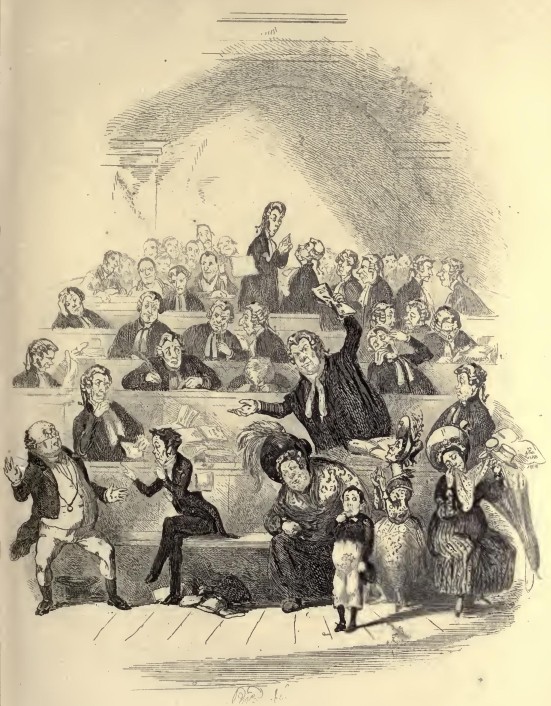

This little divergence from the subject in hand, had, of course, the intended effect of turning all eyes to Mr. Pickwick. Serjeant Buzfuz, having partially recovered from the state of moral elevation into which he had lashed himself, resumed—
‘I shall show you, gentlemen, that for two years, Pickwick continued to reside constantly, and without interruption or intermission, at Mrs. Bardell’s house. I shall show you that Mrs. Bardell, during the whole of that time, waited on him, attended to his comforts, cooked his meals, looked out his linen for the washerwoman when it went abroad, darned, aired, and prepared it for wear, when it came home, and, in short, enjoyed his fullest trust and confidence. I shall show you that, on many occasions, he gave halfpence, and on some occasions even sixpences, to her little boy; and I shall prove to you, by a witness whose testimony it will be impossible for my learned friend to weaken or controvert, that on one occasion he patted the boy on the head, and, after inquiring whether he had won any “alley tors” or “commoneys” lately (both of which I understand to be a particular species of marbles much prized by the youth of this town), made use of this remarkable expression, “How should you like to have another father?” I shall prove to you, gentlemen, that about a year ago, Pickwick suddenly began to absent himself from home, during long intervals, as if with the intention of gradually breaking off from my client; but I shall show you also, that his resolution was not at that time sufficiently strong, or that his better feelings conquered, if better feelings he has, or that the charms and accomplishments of my client prevailed against his unmanly intentions, by proving to you, that on one occasion, when he returned from the country, he distinctly and in terms, offered her marriage: previously, however, taking special care that there would be no witness to their solemn contract; and I am in a situation to prove to you, on the testimony of three of his own friends—most unwilling witnesses, gentlemen—most unwilling witnesses—that on that morning he was discovered by them holding the plaintiff in his arms, and soothing her agitation by his caresses and endearments.’
A visible impression was produced upon the auditors by this part of the learned Serjeant’s address. Drawing forth two very small scraps of paper, he proceeded—
‘And now, gentlemen, but one word more. Two letters have passed between these parties, letters which are admitted to be in the handwriting of the defendant, and which speak volumes, indeed. The letters, too, bespeak the character of the man. They are not open, fervent, eloquent epistles, breathing nothing but the language of affectionate attachment. They are covert, sly, underhanded communications, but, fortunately, far more conclusive than if couched in the most glowing language and the most poetic imagery—letters that must be viewed with a cautious and suspicious eye—letters that were evidently intended at the time, by Pickwick, to mislead and delude any third parties into whose hands they might fall. Let me read the first: “Garraways, twelve o’clock. Dear Mrs. B.—Chops and tomato sauce. Yours, Pickwick.” Gentlemen, what does this mean? Chops and tomato sauce. Yours, Pickwick! Chops! Gracious heavens! and tomato sauce! Gentlemen, is the happiness of a sensitive and confiding female to be trifled away, by such shallow artifices as these? The next has no date whatever, which is in itself suspicious. “Dear Mrs. B., I shall not be at home till to-morrow. Slow coach.” And then follows this very remarkable expression. “Don’t trouble yourself about the warming-pan.” The warming-pan! Why, gentlemen, who does trouble himself about a warming-pan? When was the peace of mind of man or woman broken or disturbed by a warming-pan, which is in itself a harmless, a useful, and I will add, gentlemen, a comforting article of domestic furniture? Why is Mrs. Bardell so earnestly entreated not to agitate herself about this warming-pan, unless (as is no doubt the case) it is a mere cover for hidden fire—a mere substitute for some endearing word or promise, agreeably to a preconcerted system of correspondence, artfully contrived by Pickwick with a view to his contemplated desertion, and which I am not in a condition to explain? And what does this allusion to the slow coach mean? For aught I know, it may be a reference to Pickwick himself, who has most unquestionably been a criminally slow coach during the whole of this transaction, but whose speed will now be very unexpectedly accelerated, and whose wheels, gentlemen, as he will find to his cost, will very soon be greased by you!’
Mr. Serjeant Buzfuz paused in this place, to see whether the jury smiled at his joke; but as nobody took it but the greengrocer, whose sensitiveness on the subject was very probably occasioned by his having subjected a chaise-cart to the process in question on that identical morning, the learned Serjeant considered it advisable to undergo a slight relapse into the dismals before he concluded.
‘But enough of this, gentlemen,’ said Mr. Serjeant Buzfuz, ‘it is difficult to smile with an aching heart; it is ill jesting when our deepest sympathies are awakened. My client’s hopes and prospects are ruined, and it is no figure of speech to say that her occupation is gone indeed. The bill is down—but there is no tenant. Eligible single gentlemen pass and repass—but there is no invitation for to inquire within or without. All is gloom and silence in the house; even the voice of the child is hushed; his infant sports are disregarded when his mother weeps; his “alley tors” and his “commoneys” are alike neglected; he forgets the long familiar cry of “knuckle down,” and at tip-cheese, or odd and even, his hand is out. But Pickwick, gentlemen, Pickwick, the ruthless destroyer of this domestic oasis in the desert of Goswell Street—Pickwick who has choked up the well, and thrown ashes on the sward—Pickwick, who comes before you to-day with his heartless tomato sauce and warming-pans—Pickwick still rears his head with unblushing effrontery, and gazes without a sigh on the ruin he has made. Damages, gentlemen—heavy damages is the only punishment with which you can visit him; the only recompense you can award to my client. And for those damages she now appeals to an enlightened, a high-minded, a right-feeling, a conscientious, a dispassionate, a sympathising, a contemplative jury of her civilised countrymen.’ With this beautiful peroration, Mr. Serjeant Buzfuz sat down, and Mr. Justice Stareleigh woke up.
‘Call Elizabeth Cluppins,’ said Serjeant Buzfuz, rising a minute afterwards, with renewed vigour.
The nearest usher called for Elizabeth Tuppins; another one, at a little distance off, demanded Elizabeth Jupkins; and a third rushed in a breathless state into King Street, and screamed for Elizabeth Muffins till he was hoarse.
Meanwhile Mrs. Cluppins, with the combined assistance of Mrs. Bardell, Mrs. Sanders, Mr. Dodson, and Mr. Fogg, was hoisted into the witness-box; and when she was safely perched on the top step, Mrs. Bardell stood on the bottom one, with the pocket-handkerchief and pattens in one hand, and a glass bottle that might hold about a quarter of a pint of smelling-salts in the other, ready for any emergency. Mrs. Sanders, whose eyes were intently fixed on the judge’s face, planted herself close by, with the large umbrella, keeping her right thumb pressed on the spring with an earnest countenance, as if she were fully prepared to put it up at a moment’s notice.
‘Mrs. Cluppins,’ said Serjeant Buzfuz, ‘pray compose yourself, ma’am.’ Of course, directly Mrs. Cluppins was desired to compose herself, she sobbed with increased vehemence, and gave divers alarming manifestations of an approaching fainting fit, or, as she afterwards said, of her feelings being too many for her.
‘Do you recollect, Mrs. Cluppins,’ said Serjeant Buzfuz, after a few unimportant questions—‘do you recollect being in Mrs. Bardell’s back one pair of stairs, on one particular morning in July last, when she was dusting Pickwick’s apartment?’
‘Yes, my Lord and jury, I do,’ replied Mrs. Cluppins.
‘Mr. Pickwick’s sitting-room was the first-floor front, I believe?’
‘Yes, it were, Sir,’ replied Mrs. Cluppins.
‘What were you doing in the back room, ma’am?’ inquired the little judge.
‘My Lord and jury,’ said Mrs. Cluppins, with interesting agitation, ‘I will not deceive you.’
‘You had better not, ma’am,’ said the little judge.
‘I was there,’ resumed Mrs. Cluppins, ‘unbeknown to Mrs. Bardell; I had been out with a little basket, gentlemen, to buy three pound of red kidney pertaties, which was three pound tuppence ha’penny, when I see Mrs. Bardell’s street door on the jar.’
‘On the what?’ exclaimed the little judge.
‘Partly open, my Lord,’ said Serjeant Snubbin.
‘She said on the jar,’ said the little judge, with a cunning look.
‘It’s all the same, my Lord,’ said Serjeant Snubbin. The little judge looked doubtful, and said he’d make a note of it. Mrs. Cluppins then resumed—
‘I walked in, gentlemen, just to say good-mornin’, and went, in a permiscuous manner, upstairs, and into the back room. Gentlemen, there was the sound of voices in the front room, and—’
‘And you listened, I believe, Mrs. Cluppins?’ said Serjeant Buzfuz.
‘Beggin’ your pardon, Sir,’ replied Mrs. Cluppins, in a majestic manner, ‘I would scorn the haction. The voices was very loud, Sir, and forced themselves upon my ear.’
‘Well, Mrs. Cluppins, you were not listening, but you heard the voices. Was one of those voices Pickwick’s?’
‘Yes, it were, Sir.’ And Mrs. Cluppins, after distinctly stating that Mr. Pickwick addressed himself to Mrs. Bardell, repeated by slow degrees, and by dint of many questions, the conversation with which our readers are already acquainted.
The jury looked suspicious, and Mr. Serjeant Buzfuz smiled as he sat down. They looked positively awful when Serjeant Snubbin intimated that he should not cross-examine the witness, for Mr. Pickwick wished it to be distinctly stated that it was due to her to say, that her account was in substance correct.
Mrs. Cluppins having once broken the ice, thought it a favourable opportunity for entering into a short dissertation on her own domestic affairs; so she straightway proceeded to inform the court that she was the mother of eight children at that present speaking, and that she entertained confident expectations of presenting Mr. Cluppins with a ninth, somewhere about that day six months. At this interesting point, the little judge interposed most irascibly; and the effect of the interposition was, that both the worthy lady and Mrs. Sanders were politely taken out of court, under the escort of Mr. Jackson, without further parley.
‘Nathaniel Winkle!’ said Mr. Skimpin.
‘Here!’ replied a feeble voice. Mr. Winkle entered the witness-box, and having been duly sworn, bowed to the judge with considerable deference.
‘Don’t look at me, Sir,’ said the judge sharply, in acknowledgment of the salute; ‘look at the jury.’
Mr. Winkle obeyed the mandate, and looked at the place where he thought it most probable the jury might be; for seeing anything in his then state of intellectual complication was wholly out of the question.
Mr. Winkle was then examined by Mr. Skimpin, who, being a promising young man of two or three-and-forty, was of course anxious to confuse a witness who was notoriously predisposed in favour of the other side, as much as he could.
‘Now, Sir,’ said Mr. Skimpin, ‘have the goodness to let his Lordship know what your name is, will you?’ and Mr. Skimpin inclined his head on one side to listen with great sharpness to the answer, and glanced at the jury meanwhile, as if to imply that he rather expected Mr. Winkle’s natural taste for perjury would induce him to give some name which did not belong to him.
‘Winkle,’ replied the witness.
‘What’s your Christian name, Sir?’ angrily inquired the little judge.
‘Nathaniel, Sir.’
‘Daniel—any other name?’
‘Nathaniel, sir—my Lord, I mean.’
‘Nathaniel Daniel, or Daniel Nathaniel?’
‘No, my Lord, only Nathaniel—not Daniel at all.’
‘What did you tell me it was Daniel for, then, sir?’ inquired the judge.
‘I didn’t, my Lord,’ replied Mr. Winkle.
‘You did, Sir,’ replied the judge, with a severe frown. ‘How could I have got Daniel on my notes, unless you told me so, Sir?’
This argument was, of course, unanswerable.
‘Mr. Winkle has rather a short memory, my Lord,’ interposed Mr. Skimpin, with another glance at the jury. ‘We shall find means to refresh it before we have quite done with him, I dare say.’
‘You had better be careful, Sir,’ said the little judge, with a sinister look at the witness.
Poor Mr. Winkle bowed, and endeavoured to feign an easiness of manner, which, in his then state of confusion, gave him rather the air of a disconcerted pickpocket.
‘Now, Mr. Winkle,’ said Mr. Skimpin, ‘attend to me, if you please, Sir; and let me recommend you, for your own sake, to bear in mind his Lordship’s injunctions to be careful. I believe you are a particular friend of Mr. Pickwick, the defendant, are you not?’
‘I have known Mr. Pickwick now, as well as I recollect at this moment, nearly—’
‘Pray, Mr. Winkle, do not evade the question. Are you, or are you not, a particular friend of the defendant’s?’
‘I was just about to say, that—’
‘Will you, or will you not, answer my question, Sir?’
If you don’t answer the question, you’ll be committed, Sir,’ interposed the little judge, looking over his note-book.
‘Come, Sir,’ said Mr. Skimpin, ‘yes or no, if you please.’
‘Yes, I am,’ replied Mr. Winkle.
‘Yes, you are. And why couldn’t you say that at once, Sir? Perhaps you know the plaintiff too? Eh, Mr. Winkle?’
‘I don’t know her; I’ve seen her.’
‘Oh, you don’t know her, but you’ve seen her? Now, have the goodness to tell the gentlemen of the jury what you mean by that, Mr. Winkle.’
‘I mean that I am not intimate with her, but I have seen her when I went to call on Mr. Pickwick, in Goswell Street.’
‘How often have you seen her, Sir?’
‘How often?’
‘Yes, Mr. Winkle, how often? I’ll repeat the question for you a dozen times, if you require it, Sir.’ And the learned gentleman, with a firm and steady frown, placed his hands on his hips, and smiled suspiciously to the jury.
On this question there arose the edifying brow-beating, customary on such points. First of all, Mr. Winkle said it was quite impossible for him to say how many times he had seen Mrs. Bardell. Then he was asked if he had seen her twenty times, to which he replied, ‘Certainly—more than that.’ Then he was asked whether he hadn’t seen her a hundred times—whether he couldn’t swear that he had seen her more than fifty times—whether he didn’t know that he had seen her at least seventy-five times, and so forth; the satisfactory conclusion which was arrived at, at last, being, that he had better take care of himself, and mind what he was about. The witness having been by these means reduced to the requisite ebb of nervous perplexity, the examination was continued as follows—
‘Pray, Mr. Winkle, do you remember calling on the defendant Pickwick at these apartments in the plaintiff’s house in Goswell Street, on one particular morning, in the month of July last?’
‘Yes, I do.’
‘Were you accompanied on that occasion by a friend of the name of Tupman, and another by the name of Snodgrass?’
‘Yes, I was.’
‘Are they here?’
Yes, they are,’ replied Mr. Winkle, looking very earnestly towards the spot where his friends were stationed.
‘Pray attend to me, Mr. Winkle, and never mind your friends,’ said Mr. Skimpin, with another expressive look at the jury. ‘They must tell their stories without any previous consultation with you, if none has yet taken place (another look at the jury). Now, Sir, tell the gentlemen of the jury what you saw on entering the defendant’s room, on this particular morning. Come; out with it, Sir; we must have it, sooner or later.’
‘The defendant, Mr. Pickwick, was holding the plaintiff in his arms, with his hands clasping her waist,’ replied Mr. Winkle with natural hesitation, ‘and the plaintiff appeared to have fainted away.’
‘Did you hear the defendant say anything?’
‘I heard him call Mrs. Bardell a good creature, and I heard him ask her to compose herself, for what a situation it was, if anybody should come, or words to that effect.’
‘Now, Mr. Winkle, I have only one more question to ask you, and I beg you to bear in mind his Lordship’s caution. Will you undertake to swear that Pickwick, the defendant, did not say on the occasion in question—“My dear Mrs. Bardell, you’re a good creature; compose yourself to this situation, for to this situation you must come,” or words to that effect?’
‘I—I didn’t understand him so, certainly,’ said Mr. Winkle, astounded on this ingenious dove-tailing of the few words he had heard. ‘I was on the staircase, and couldn’t hear distinctly; the impression on my mind is—’
‘The gentlemen of the jury want none of the impressions on your mind, Mr. Winkle, which I fear would be of little service to honest, straightforward men,’ interposed Mr. Skimpin. ‘You were on the staircase, and didn’t distinctly hear; but you will not swear that Pickwick did not make use of the expressions I have quoted? Do I understand that?’
‘No, I will not,’ replied Mr. Winkle; and down sat Mr. Skimpin with a triumphant countenance.
Mr. Pickwick’s case had not gone off in so particularly happy a manner, up to this point, that it could very well afford to have any additional suspicion cast upon it. But as it could afford to be placed in a rather better light, if possible, Mr. Phunky rose for the purpose of getting something important out of Mr. Winkle in cross-examination. Whether he did get anything important out of him, will immediately appear.
‘I believe, Mr. Winkle,’ said Mr. Phunky, ‘that Mr. Pickwick is not a young man?’
‘Oh, no,’ replied Mr. Winkle; ‘old enough to be my father.’
‘You have told my learned friend that you have known Mr. Pickwick a long time. Had you ever any reason to suppose or believe that he was about to be married?’
‘Oh, no; certainly not;’ replied Mr. Winkle with so much eagerness, that Mr. Phunky ought to have got him out of the box with all possible dispatch. Lawyers hold that there are two kinds of particularly bad witnesses—a reluctant witness, and a too-willing witness; it was Mr. Winkle’s fate to figure in both characters.
‘I will even go further than this, Mr. Winkle,’ continued Mr. Phunky, in a most smooth and complacent manner. ‘Did you ever see anything in Mr. Pickwick’s manner and conduct towards the opposite sex, to induce you to believe that he ever contemplated matrimony of late years, in any case?’
‘Oh, no; certainly not,’ replied Mr. Winkle.
‘Has his behaviour, when females have been in the case, always been that of a man, who, having attained a pretty advanced period of life, content with his own occupations and amusements, treats them only as a father might his daughters?’
‘Not the least doubt of it,’ replied Mr. Winkle, in the fulness of his heart. ‘That is—yes—oh, yes—certainly.’
‘You have never known anything in his behaviour towards Mrs. Bardell, or any other female, in the least degree suspicious?’ said Mr. Phunky, preparing to sit down; for Serjeant Snubbin was winking at him.
‘N-n-no,’ replied Mr. Winkle, ‘except on one trifling occasion, which, I have no doubt, might be easily explained.’
Now, if the unfortunate Mr. Phunky had sat down when Serjeant Snubbin had winked at him, or if Serjeant Buzfuz had stopped this irregular cross-examination at the outset (which he knew better than to do; observing Mr. Winkle’s anxiety, and well knowing it would, in all probability, lead to something serviceable to him), this unfortunate admission would not have been elicited. The moment the words fell from Mr. Winkle’s lips, Mr. Phunky sat down, and Serjeant Snubbin rather hastily told him he might leave the box, which Mr. Winkle prepared to do with great readiness, when Serjeant Buzfuz stopped him.
‘Stay, Mr. Winkle, stay!’ said Serjeant Buzfuz, ‘will your Lordship have the goodness to ask him, what this one instance of suspicious behaviour towards females on the part of this gentleman, who is old enough to be his father, was?’
‘You hear what the learned counsel says, Sir,’ observed the judge, turning to the miserable and agonised Mr. Winkle. ‘Describe the occasion to which you refer.’
‘My Lord,’ said Mr. Winkle, trembling with anxiety, ‘I—I’d rather not.’
‘Perhaps so,’ said the little judge; ‘but you must.’
Amid the profound silence of the whole court, Mr. Winkle faltered out, that the trifling circumstance of suspicion was Mr. Pickwick’s being found in a lady’s sleeping-apartment at midnight; which had terminated, he believed, in the breaking off of the projected marriage of the lady in question, and had led, he knew, to the whole party being forcibly carried before George Nupkins, Esq., magistrate and justice of the peace, for the borough of Ipswich!
‘You may leave the box, Sir,’ said Serjeant Snubbin. Mr. Winkle did leave the box, and rushed with delirious haste to the George and Vulture, where he was discovered some hours after, by the waiter, groaning in a hollow and dismal manner, with his head buried beneath the sofa cushions.
Tracy Tupman, and Augustus Snodgrass, were severally called into the box; both corroborated the testimony of their unhappy friend; and each was driven to the verge of desperation by excessive badgering.
Susannah Sanders was then called, and examined by Serjeant Buzfuz, and cross-examined by Serjeant Snubbin. Had always said and believed that Pickwick would marry Mrs. Bardell; knew that Mrs. Bardell’s being engaged to Pickwick was the current topic of conversation in the neighbourhood, after the fainting in July; had been told it herself by Mrs. Mudberry which kept a mangle, and Mrs. Bunkin which clear-starched, but did not see either Mrs. Mudberry or Mrs. Bunkin in court. Had heard Pickwick ask the little boy how he should like to have another father. Did not know that Mrs. Bardell was at that time keeping company with the baker, but did know that the baker was then a single man and is now married. Couldn’t swear that Mrs. Bardell was not very fond of the baker, but should think that the baker was not very fond of Mrs. Bardell, or he wouldn’t have married somebody else. Thought Mrs. Bardell fainted away on the morning in July, because Pickwick asked her to name the day: knew that she (witness) fainted away stone dead when Mr. Sanders asked her to name the day, and believed that everybody as called herself a lady would do the same, under similar circumstances. Heard Pickwick ask the boy the question about the marbles, but upon her oath did not know the difference between an ‘alley tor’ and a ‘commoney.’
By the court.—During the period of her keeping company with Mr. Sanders, had received love letters, like other ladies. In the course of their correspondence Mr. Sanders had often called her a ‘duck,’ but never ‘chops,’ nor yet ‘tomato sauce.’ He was particularly fond of ducks. Perhaps if he had been as fond of chops and tomato sauce, he might have called her that, as a term of affection.
Serjeant Buzfuz now rose with more importance than he had yet exhibited, if that were possible, and vociferated; ‘Call Samuel Weller.’
It was quite unnecessary to call Samuel Weller; for Samuel Weller stepped briskly into the box the instant his name was pronounced; and placing his hat on the floor, and his arms on the rail, took a bird’s-eye view of the Bar, and a comprehensive survey of the Bench, with a remarkably cheerful and lively aspect.
‘What’s your name, sir?’ inquired the judge.
‘Sam Weller, my Lord,’ replied that gentleman.
‘Do you spell it with a “V” or a “W”?’ inquired the judge.
‘That depends upon the taste and fancy of the speller, my Lord,’ replied Sam; ‘I never had occasion to spell it more than once or twice in my life, but I spells it with a “V.”’
Here a voice in the gallery exclaimed aloud, ‘Quite right too, Samivel, quite right. Put it down a “we,” my Lord, put it down a “we.”’
Who is that, who dares address the court?’ said the little judge, looking up. ‘Usher.’
‘Yes, my Lord.’
‘Bring that person here instantly.’
‘Yes, my Lord.’
But as the usher didn’t find the person, he didn’t bring him; and, after a great commotion, all the people who had got up to look for the culprit, sat down again. The little judge turned to the witness as soon as his indignation would allow him to speak, and said—
‘Do you know who that was, sir?’
‘I rayther suspect it was my father, my lord,’ replied Sam.
‘Do you see him here now?’ said the judge.
‘No, I don’t, my Lord,’ replied Sam, staring right up into the lantern at the roof of the court.
‘If you could have pointed him out, I would have committed him instantly,’ said the judge. Sam bowed his acknowledgments and turned, with unimpaired cheerfulness of countenance, towards Serjeant Buzfuz.
‘Now, Mr. Weller,’ said Serjeant Buzfuz.
‘Now, sir,’ replied Sam.
‘I believe you are in the service of Mr. Pickwick, the defendant in this case? Speak up, if you please, Mr. Weller.’
‘I mean to speak up, Sir,’ replied Sam; ‘I am in the service o’ that ‘ere gen’l’man, and a wery good service it is.’
‘Little to do, and plenty to get, I suppose?’ said Serjeant Buzfuz, with jocularity.
‘Oh, quite enough to get, Sir, as the soldier said ven they ordered him three hundred and fifty lashes,’ replied Sam.
‘You must not tell us what the soldier, or any other man, said, Sir,’ interposed the judge; ‘it’s not evidence.’
‘Wery good, my Lord,’ replied Sam.
‘Do you recollect anything particular happening on the morning when you were first engaged by the defendant; eh, Mr. Weller?’ said Serjeant Buzfuz.
‘Yes, I do, sir,’ replied Sam.
‘Have the goodness to tell the jury what it was.’
‘I had a reg’lar new fit out o’ clothes that mornin’, gen’l’men of the jury,’ said Sam, ‘and that was a wery partickler and uncommon circumstance vith me in those days.’
Hereupon there was a general laugh; and the little judge, looking with an angry countenance over his desk, said, ‘You had better be careful, Sir.’
‘So Mr. Pickwick said at the time, my Lord,’ replied Sam; ‘and I was wery careful o’ that ‘ere suit o’ clothes; wery careful indeed, my Lord.’
The judge looked sternly at Sam for full two minutes, but Sam’s features were so perfectly calm and serene that the judge said nothing, and motioned Serjeant Buzfuz to proceed.
‘Do you mean to tell me, Mr. Weller,’ said Serjeant Buzfuz, folding his arms emphatically, and turning half-round to the jury, as if in mute assurance that he would bother the witness yet—‘do you mean to tell me, Mr. Weller, that you saw nothing of this fainting on the part of the plaintiff in the arms of the defendant, which you have heard described by the witnesses?’
Certainly not,’ replied Sam; ‘I was in the passage till they called me up, and then the old lady was not there.’
‘Now, attend, Mr. Weller,’ said Serjeant Buzfuz, dipping a large pen into the inkstand before him, for the purpose of frightening Sam with a show of taking down his answer. ‘You were in the passage, and yet saw nothing of what was going forward. Have you a pair of eyes, Mr. Weller?’
‘Yes, I have a pair of eyes,’ replied Sam, ‘and that’s just it. If they wos a pair o’ patent double million magnifyin’ gas microscopes of hextra power, p’raps I might be able to see through a flight o’ stairs and a deal door; but bein’ only eyes, you see, my wision ‘s limited.’
At this answer, which was delivered without the slightest appearance of irritation, and with the most complete simplicity and equanimity of manner, the spectators tittered, the little judge smiled, and Serjeant Buzfuz looked particularly foolish. After a short consultation with Dodson & Fogg, the learned Serjeant again turned towards Sam, and said, with a painful effort to conceal his vexation, ‘Now, Mr. Weller, I’ll ask you a question on another point, if you please.’
‘If you please, Sir,’ rejoined Sam, with the utmost good-humour.
‘Do you remember going up to Mrs. Bardell’s house, one night in November last?’
Oh, yes, wery well.’
‘Oh, you do remember that, Mr. Weller,’ said Serjeant Buzfuz, recovering his spirits; ‘I thought we should get at something at last.’
‘I rayther thought that, too, sir,’ replied Sam; and at this the spectators tittered again.
‘Well; I suppose you went up to have a little talk about this trial—eh, Mr. Weller?’ said Serjeant Buzfuz, looking knowingly at the jury.
‘I went up to pay the rent; but we did get a-talkin’ about the trial,’ replied Sam.
‘Oh, you did get a-talking about the trial,’ said Serjeant Buzfuz, brightening up with the anticipation of some important discovery. ‘Now, what passed about the trial; will you have the goodness to tell us, Mr. Weller’?’
‘Vith all the pleasure in life, sir,’ replied Sam. ‘Arter a few unimportant obserwations from the two wirtuous females as has been examined here to-day, the ladies gets into a very great state o’ admiration at the honourable conduct of Mr. Dodson and Fogg—them two gen’l’men as is settin’ near you now.’ This, of course, drew general attention to Dodson & Fogg, who looked as virtuous as possible.
‘The attorneys for the plaintiff,’ said Mr. Serjeant Buzfuz. ‘Well! They spoke in high praise of the honourable conduct of Messrs. Dodson and Fogg, the attorneys for the plaintiff, did they?’
‘Yes,’ said Sam, ‘they said what a wery gen’rous thing it was o’ them to have taken up the case on spec, and to charge nothing at all for costs, unless they got ‘em out of Mr. Pickwick.’
At this very unexpected reply, the spectators tittered again, and Dodson & Fogg, turning very red, leaned over to Serjeant Buzfuz, and in a hurried manner whispered something in his ear.
‘You are quite right,’ said Serjeant Buzfuz aloud, with affected composure. ‘It’s perfectly useless, my Lord, attempting to get at any evidence through the impenetrable stupidity of this witness. I will not trouble the court by asking him any more questions. Stand down, sir.’
‘Would any other gen’l’man like to ask me anythin’?’ inquired Sam, taking up his hat, and looking round most deliberately.
‘Not I, Mr. Weller, thank you,’ said Serjeant Snubbin, laughing.
‘You may go down, sir,’ said Serjeant Buzfuz, waving his hand impatiently. Sam went down accordingly, after doing Messrs. Dodson & Fogg’s case as much harm as he conveniently could, and saying just as little respecting Mr. Pickwick as might be, which was precisely the object he had had in view all along.
‘I have no objection to admit, my Lord,’ said Serjeant Snubbin, ‘if it will save the examination of another witness, that Mr. Pickwick has retired from business, and is a gentleman of considerable independent property.’
‘Very well,’ said Serjeant Buzfuz, putting in the two letters to be read, ‘then that’s my case, my Lord.’
Serjeant Snubbin then addressed the jury on behalf of the defendant; and a very long and a very emphatic address he delivered, in which he bestowed the highest possible eulogiums on the conduct and character of Mr. Pickwick; but inasmuch as our readers are far better able to form a correct estimate of that gentleman’s merits and deserts, than Serjeant Snubbin could possibly be, we do not feel called upon to enter at any length into the learned gentleman’s observations. He attempted to show that the letters which had been exhibited, merely related to Mr. Pickwick’s dinner, or to the preparations for receiving him in his apartments on his return from some country excursion. It is sufficient to add in general terms, that he did the best he could for Mr. Pickwick; and the best, as everybody knows, on the infallible authority of the old adage, could do no more.
Mr. Justice Stareleigh summed up, in the old-established and most approved form. He read as much of his notes to the jury as he could decipher on so short a notice, and made running-comments on the evidence as he went along. If Mrs. Bardell were right, it was perfectly clear that Mr. Pickwick was wrong, and if they thought the evidence of Mrs. Cluppins worthy of credence they would believe it, and, if they didn’t, why, they wouldn’t. If they were satisfied that a breach of promise of marriage had been committed they would find for the plaintiff with such damages as they thought proper; and if, on the other hand, it appeared to them that no promise of marriage had ever been given, they would find for the defendant with no damages at all. The jury then retired to their private room to talk the matter over, and the judge retired to his private room, to refresh himself with a mutton chop and a glass of sherry.
An anxious quarter of a hour elapsed; the jury came back; the judge was fetched in. Mr. Pickwick put on his spectacles, and gazed at the foreman with an agitated countenance and a quickly-beating heart.
‘Gentlemen,’ said the individual in black, ‘are you all agreed upon your verdict?’
‘We are,’ replied the foreman.
‘Do you find for the plaintiff, gentlemen, or for the defendant?’
For the plaintiff.’
‘With what damages, gentlemen?’
‘Seven hundred and fifty pounds.’
Mr. Pickwick took off his spectacles, carefully wiped the glasses, folded them into their case, and put them in his pocket; then, having drawn on his gloves with great nicety, and stared at the foreman all the while, he mechanically followed Mr. Perker and the blue bag out of court.
They stopped in a side room while Perker paid the court fees; and here, Mr. Pickwick was joined by his friends. Here, too, he encountered Messrs. Dodson & Fogg, rubbing their hands with every token of outward satisfaction.
‘Well, gentlemen,’ said Mr. Pickwick.
‘Well, Sir,’ said Dodson, for self and partner.
‘You imagine you’ll get your costs, don’t you, gentlemen?’ said Mr. Pickwick.
Fogg said they thought it rather probable. Dodson smiled, and said they’d try.
‘You may try, and try, and try again, Messrs. Dodson and Fogg,’ said Mr. Pickwick vehemently, ‘but not one farthing of costs or damages do you ever get from me, if I spend the rest of my existence in a debtor’s prison.’
‘Ha! ha!’ laughed Dodson. ‘You’ll think better of that, before next term, Mr. Pickwick.’
‘He, he, he! We’ll soon see about that, Mr. Pickwick,’ grinned Fogg.
Speechless with indignation, Mr. Pickwick allowed himself to be led by his solicitor and friends to the door, and there assisted into a hackney-coach, which had been fetched for the purpose, by the ever-watchful Sam Weller.
Sam had put up the steps, and was preparing to jump upon the box, when he felt himself gently touched on the shoulder; and, looking round, his father stood before him. The old gentleman’s countenance wore a mournful expression, as he shook his head gravely, and said, in warning accents—
‘I know’d what ‘ud come o’ this here mode o’ doin’ bisness. Oh, Sammy, Sammy, vy worn’t there a alleybi!’
CHAPTER XXXV. IN WHICH MR. PICKWICK THINKS HE HAD BETTER GO TO BATH; AND GOES ACCORDINGLY
But surely, my dear sir,’ said little Perker, as he stood in Mr. Pickwick’s apartment on the morning after the trial, ‘surely you don’t really mean—really and seriously now, and irritation apart—that you won’t pay these costs and damages?’
‘Not one halfpenny,’ said Mr. Pickwick firmly; ‘not one halfpenny.’
‘Hooroar for the principle, as the money-lender said ven he vouldn’t renew the bill,’ observed Mr. Weller, who was clearing away the breakfast-things.
‘Sam,’ said Mr. Pickwick, ‘have the goodness to step downstairs.’
‘Cert’nly, sir,’ replied Mr. Weller; and acting on Mr. Pickwick’s gentle hint, Sam retired.
‘No, Perker,’ said Mr. Pickwick, with great seriousness of manner, ‘my friends here have endeavoured to dissuade me from this determination, but without avail. I shall employ myself as usual, until the opposite party have the power of issuing a legal process of execution against me; and if they are vile enough to avail themselves of it, and to arrest my person, I shall yield myself up with perfect cheerfulness and content of heart. When can they do this?’
‘They can issue execution, my dear Sir, for the amount of the damages and taxed costs, next term,’ replied Perker, ‘just two months hence, my dear sir.’
‘Very good,’ said Mr. Pickwick. ‘Until that time, my dear fellow, let me hear no more of the matter. And now,’ continued Mr. Pickwick, looking round on his friends with a good-humoured smile, and a sparkle in the eye which no spectacles could dim or conceal, ‘the only question is, Where shall we go next?’
Mr. Tupman and Mr. Snodgrass were too much affected by their friend’s heroism to offer any reply. Mr. Winkle had not yet sufficiently recovered the recollection of his evidence at the trial, to make any observation on any subject, so Mr. Pickwick paused in vain.
‘Well,’ said that gentleman, ‘if you leave me to suggest our destination, I say Bath. I think none of us have ever been there.’
Nobody had; and as the proposition was warmly seconded by Perker, who considered it extremely probable that if Mr. Pickwick saw a little change and gaiety he would be inclined to think better of his determination, and worse of a debtor’s prison, it was carried unanimously; and Sam was at once despatched to the White Horse Cellar, to take five places by the half-past seven o’clock coach, next morning.
There were just two places to be had inside, and just three to be had out; so Sam Weller booked for them all, and having exchanged a few compliments with the booking-office clerk on the subject of a pewter half-crown which was tendered him as a portion of his ‘change,’ walked back to the George and Vulture, where he was pretty busily employed until bed-time in reducing clothes and linen into the smallest possible compass, and exerting his mechanical genius in constructing a variety of ingenious devices for keeping the lids on boxes which had neither locks nor hinges.
The next was a very unpropitious morning for a journey—muggy, damp, and drizzly. The horses in the stages that were going out, and had come through the city, were smoking so, that the outside passengers were invisible. The newspaper-sellers looked moist, and smelled mouldy; the wet ran off the hats of the orange-vendors as they thrust their heads into the coach windows, and diluted the insides in a refreshing manner. The Jews with the fifty-bladed penknives shut them up in despair; the men with the pocket-books made pocket-books of them. Watch-guards and toasting-forks were alike at a discount, and pencil-cases and sponges were a drug in the market.
Leaving Sam Weller to rescue the luggage from the seven or eight porters who flung themselves savagely upon it, the moment the coach stopped, and finding that they were about twenty minutes too early, Mr. Pickwick and his friends went for shelter into the travellers’ room—the last resource of human dejection.
The travellers’ room at the White Horse Cellar is of course uncomfortable; it would be no travellers’ room if it were not. It is the right-hand parlour, into which an aspiring kitchen fireplace appears to have walked, accompanied by a rebellious poker, tongs, and shovel. It is divided into boxes, for the solitary confinement of travellers, and is furnished with a clock, a looking-glass, and a live waiter, which latter article is kept in a small kennel for washing glasses, in a corner of the apartment.
One of these boxes was occupied, on this particular occasion, by a stern-eyed man of about five-and-forty, who had a bald and glossy forehead, with a good deal of black hair at the sides and back of his head, and large black whiskers. He was buttoned up to the chin in a brown coat; and had a large sealskin travelling-cap, and a greatcoat and cloak, lying on the seat beside him. He looked up from his breakfast as Mr. Pickwick entered, with a fierce and peremptory air, which was very dignified; and, having scrutinised that gentleman and his companions to his entire satisfaction, hummed a tune, in a manner which seemed to say that he rather suspected somebody wanted to take advantage of him, but it wouldn’t do.
‘Waiter,’ said the gentleman with the whiskers.
‘Sir?’ replied a man with a dirty complexion, and a towel of the same, emerging from the kennel before mentioned.
‘Some more toast.’
‘Yes, sir.’
‘Buttered toast, mind,’ said the gentleman fiercely.
‘Directly, sir,’ replied the waiter.
The gentleman with the whiskers hummed a tune in the same manner as before, and pending the arrival of the toast, advanced to the front of the fire, and, taking his coat tails under his arms, looked at his boots and ruminated.
‘I wonder whereabouts in Bath this coach puts up,’ said Mr. Pickwick, mildly addressing Mr. Winkle.
‘Hum—eh—what’s that?’ said the strange man.
‘I made an observation to my friend, sir,’ replied Mr. Pickwick, always ready to enter into conversation. ‘I wondered at what house the Bath coach put up. Perhaps you can inform me.’
Are you going to Bath?’ said the strange man.
‘I am, sir,’ replied Mr. Pickwick.
‘And those other gentlemen?’
‘They are going also,’ said Mr. Pickwick.
‘Not inside—I’ll be damned if you’re going inside,’ said the strange man.
‘Not all of us,’ said Mr. Pickwick.
‘No, not all of you,’ said the strange man emphatically. ‘I’ve taken two places. If they try to squeeze six people into an infernal box that only holds four, I’ll take a post-chaise and bring an action. I’ve paid my fare. It won’t do; I told the clerk when I took my places that it wouldn’t do. I know these things have been done. I know they are done every day; but I never was done, and I never will be. Those who know me best, best know it; crush me!’ Here the fierce gentleman rang the bell with great violence, and told the waiter he’d better bring the toast in five seconds, or he’d know the reason why.
‘My good sir,’ said Mr. Pickwick, ‘you will allow me to observe that this is a very unnecessary display of excitement. I have only taken places inside for two.’
‘I am glad to hear it,’ said the fierce man. ‘I withdraw my expressions. I tender an apology. There’s my card. Give me your acquaintance.’
‘With great pleasure, Sir,’ replied Mr. Pickwick. ‘We are to be fellow-travellers, and I hope we shall find each other’s society mutually agreeable.’
‘I hope we shall,’ said the fierce gentleman. ‘I know we shall. I like your looks; they please me. Gentlemen, your hands and names. Know me.’
Of course, an interchange of friendly salutations followed this gracious speech; and the fierce gentleman immediately proceeded to inform the friends, in the same short, abrupt, jerking sentences, that his name was Dowler; that he was going to Bath on pleasure; that he was formerly in the army; that he had now set up in business as a gentleman; that he lived upon the profits; and that the individual for whom the second place was taken, was a personage no less illustrious than Mrs. Dowler, his lady wife.
‘She’s a fine woman,’ said Mr. Dowler. ‘I am proud of her. I have reason.’
‘I hope I shall have the pleasure of judging,’ said Mr. Pickwick, with a smile.
‘You shall,’ replied Dowler. ‘She shall know you. She shall esteem you. I courted her under singular circumstances. I won her through a rash vow. Thus. I saw her; I loved her; I proposed; she refused me.—“You love another?”—“Spare my blushes.”—“I know him.”—“You do.”—“Very good; if he remains here, I’ll skin him.”’
‘Lord bless me!’ exclaimed Mr. Pickwick involuntarily.
‘Did you skin the gentleman, Sir?’ inquired Mr. Winkle, with a very pale face.
‘I wrote him a note, I said it was a painful thing. And so it was.’
‘Certainly,’ interposed Mr. Winkle.
‘I said I had pledged my word as a gentleman to skin him. My character was at stake. I had no alternative. As an officer in His Majesty’s service, I was bound to skin him. I regretted the necessity, but it must be done. He was open to conviction. He saw that the rules of the service were imperative. He fled. I married her. Here’s the coach. That’s her head.’
As Mr. Dowler concluded, he pointed to a stage which had just driven up, from the open window of which a rather pretty face in a bright blue bonnet was looking among the crowd on the pavement, most probably for the rash man himself. Mr. Dowler paid his bill, and hurried out with his travelling cap, coat, and cloak; and Mr. Pickwick and his friends followed to secure their places.
Mr. Tupman and Mr. Snodgrass had seated themselves at the back part of the coach; Mr. Winkle had got inside; and Mr. Pickwick was preparing to follow him, when Sam Weller came up to his master, and whispering in his ear, begged to speak to him, with an air of the deepest mystery.
‘Well, Sam,’ said Mr. Pickwick, ‘what’s the matter now?’
‘Here’s rayther a rum go, sir,’ replied Sam.
‘What?’ inquired Mr. Pickwick.
‘This here, Sir,’ rejoined Sam. ‘I’m wery much afeerd, sir, that the properiator o’ this here coach is a playin’ some imperence vith us.’
‘How is that, Sam?’ said Mr. Pickwick; ‘aren’t the names down on the way-bill?’
‘The names is not only down on the vay-bill, Sir,’ replied Sam, ‘but they’ve painted vun on ‘em up, on the door o’ the coach.’ As Sam spoke, he pointed to that part of the coach door on which the proprietor’s name usually appears; and there, sure enough, in gilt letters of a goodly size, was the magic name of Pickwick!
‘Dear me,’ exclaimed Mr. Pickwick, quite staggered by the coincidence; ‘what a very extraordinary thing!’
‘Yes, but that ain’t all,’ said Sam, again directing his master’s attention to the coach door; ‘not content vith writin’ up “Pick-wick,” they puts “Moses” afore it, vich I call addin’ insult to injury, as the parrot said ven they not only took him from his native land, but made him talk the English langwidge arterwards.’
‘It’s odd enough, certainly, Sam,’ said Mr. Pickwick; ‘but if we stand talking here, we shall lose our places.’
‘Wot, ain’t nothin’ to be done in consequence, sir?’ exclaimed Sam, perfectly aghast at the coolness with which Mr. Pickwick prepared to ensconce himself inside.
‘Done!’ said Mr. Pickwick. ‘What should be done?’
Ain’t nobody to be whopped for takin’ this here liberty, sir?’ said Mr. Weller, who had expected that at least he would have been commissioned to challenge the guard and the coachman to a pugilistic encounter on the spot.
‘Certainly not,’ replied Mr. Pickwick eagerly; ‘not on any account. Jump up to your seat directly.’
‘I am wery much afeered,’ muttered Sam to himself, as he turned away, ‘that somethin’ queer’s come over the governor, or he’d never ha’ stood this so quiet. I hope that ‘ere trial hasn’t broke his spirit, but it looks bad, wery bad.’ Mr. Weller shook his head gravely; and it is worthy of remark, as an illustration of the manner in which he took this circumstance to heart, that he did not speak another word until the coach reached the Kensington turnpike. Which was so long a time for him to remain taciturn, that the fact may be considered wholly unprecedented.
Nothing worthy of special mention occurred during the journey. Mr. Dowler related a variety of anecdotes, all illustrative of his own personal prowess and desperation, and appealed to Mrs. Dowler in corroboration thereof; when Mrs. Dowler invariably brought in, in the form of an appendix, some remarkable fact or circumstance which Mr. Dowler had forgotten, or had perhaps through modesty, omitted; for the addenda in every instance went to show that Mr. Dowler was even a more wonderful fellow than he made himself out to be. Mr. Pickwick and Mr. Winkle listened with great admiration, and at intervals conversed with Mrs. Dowler, who was a very agreeable and fascinating person. So, what between Mr. Dowler’s stories, and Mrs. Dowler’s charms, and Mr. Pickwick’s good-humour, and Mr. Winkle’s good listening, the insides contrived to be very companionable all the way.
The outsides did as outsides always do. They were very cheerful and talkative at the beginning of every stage, and very dismal and sleepy in the middle, and very bright and wakeful again towards the end. There was one young gentleman in an India-rubber cloak, who smoked cigars all day; and there was another young gentleman in a parody upon a greatcoat, who lighted a good many, and feeling obviously unsettled after the second whiff, threw them away when he thought nobody was looking at him. There was a third young man on the box who wished to be learned in cattle; and an old one behind, who was familiar with farming. There was a constant succession of Christian names in smock-frocks and white coats, who were invited to have a ‘lift’ by the guard, and who knew every horse and hostler on the road and off it; and there was a dinner which would have been cheap at half-a-crown a mouth, if any moderate number of mouths could have eaten it in the time. And at seven o’clock P.M. Mr. Pickwick and his friends, and Mr. Dowler and his wife, respectively retired to their private sitting-rooms at the White Hart Hotel, opposite the Great Pump Room, Bath, where the waiters, from their costume, might be mistaken for Westminster boys, only they destroy the illusion by behaving themselves much better.
Breakfast had scarcely been cleared away on the succeeding morning, when a waiter brought in Mr. Dowler’s card, with a request to be allowed permission to introduce a friend. Mr. Dowler at once followed up the delivery of the card, by bringing himself and the friend also.
The friend was a charming young man of not much more than fifty, dressed in a very bright blue coat with resplendent buttons, black trousers, and the thinnest possible pair of highly-polished boots. A gold eye-glass was suspended from his neck by a short, broad, black ribbon; a gold snuff-box was lightly clasped in his left hand; gold rings innumerable glittered on his fingers; and a large diamond pin set in gold glistened in his shirt frill. He had a gold watch, and a gold curb chain with large gold seals; and he carried a pliant ebony cane with a gold top. His linen was of the very whitest, finest, and stiffest; his wig of the glossiest, blackest, and curliest. His snuff was princes’ mixture; his scent bouquet du roi. His features were contracted into a perpetual smile; and his teeth were in such perfect order that it was difficult at a small distance to tell the real from the false.
‘Mr. Pickwick,’ said Mr. Dowler; ‘my friend, Angelo Cyrus Bantam, Esquire, M.C.; Bantam; Mr. Pickwick. Know each other.’
‘Welcome to Ba—ath, Sir. This is indeed an acquisition. Most welcome to Ba—ath, sir. It is long—very long, Mr. Pickwick, since you drank the waters. It appears an age, Mr. Pickwick. Re-markable!’
Such were the expressions with which Angelo Cyrus Bantam, Esquire, M.C., took Mr. Pickwick’s hand; retaining it in his, meantime, and shrugging up his shoulders with a constant succession of bows, as if he really could not make up his mind to the trial of letting it go again.
‘It is a very long time since I drank the waters, certainly,’ replied Mr. Pickwick; ‘for, to the best of my knowledge, I was never here before.’
‘Never in Ba—ath, Mr. Pickwick!’ exclaimed the Grand Master, letting the hand fall in astonishment. ‘Never in Ba—ath! He! he! Mr. Pickwick, you are a wag. Not bad, not bad. Good, good. He! he! he! Re-markable!’
‘To my shame, I must say that I am perfectly serious,’ rejoined Mr. Pickwick. ‘I really never was here before.’
‘Oh, I see,’ exclaimed the Grand Master, looking extremely pleased; ‘yes, yes—good, good—better and better. You are the gentleman of whom we have heard. Yes; we know you, Mr. Pickwick; we know you.’
‘The reports of the trial in those confounded papers,’ thought Mr. Pickwick. ‘They have heard all about me.’
You are the gentleman residing on Clapham Green,’ resumed Bantam, ‘who lost the use of his limbs from imprudently taking cold after port wine; who could not be moved in consequence of acute suffering, and who had the water from the king’s bath bottled at one hundred and three degrees, and sent by wagon to his bedroom in town, where he bathed, sneezed, and the same day recovered. Very remarkable!’
Mr. Pickwick acknowledged the compliment which the supposition implied, but had the self-denial to repudiate it, notwithstanding; and taking advantage of a moment’s silence on the part of the M.C., begged to introduce his friends, Mr. Tupman, Mr. Winkle, and Mr. Snodgrass. An introduction which overwhelmed the M.C. with delight and honour.
‘Bantam,’ said Mr. Dowler, ‘Mr. Pickwick and his friends are strangers. They must put their names down. Where’s the book?’
‘The register of the distinguished visitors in Ba—ath will be at the Pump Room this morning at two o’clock,’ replied the M.C. ‘Will you guide our friends to that splendid building, and enable me to procure their autographs?’
‘I will,’ rejoined Dowler. ‘This is a long call. It’s time to go. I shall be here again in an hour. Come.’
‘This is a ball-night,’ said the M.C., again taking Mr. Pickwick’s hand, as he rose to go. ‘The ball-nights in Ba—ath are moments snatched from paradise; rendered bewitching by music, beauty, elegance, fashion, etiquette, and—and—above all, by the absence of tradespeople, who are quite inconsistent with paradise, and who have an amalgamation of themselves at the Guildhall every fortnight, which is, to say the least, remarkable. Good-bye, good-bye!’ and protesting all the way downstairs that he was most satisfied, and most delighted, and most overpowered, and most flattered, Angelo Cyrus Bantam, Esquire, M.C., stepped into a very elegant chariot that waited at the door, and rattled off.
At the appointed hour, Mr. Pickwick and his friends, escorted by Dowler, repaired to the Assembly Rooms, and wrote their names down in the book—an instance of condescension at which Angelo Bantam was even more overpowered than before. Tickets of admission to that evening’s assembly were to have been prepared for the whole party, but as they were not ready, Mr. Pickwick undertook, despite all the protestations to the contrary of Angelo Bantam, to send Sam for them at four o’clock in the afternoon, to the M.C.‘s house in Queen Square. Having taken a short walk through the city, and arrived at the unanimous conclusion that Park Street was very much like the perpendicular streets a man sees in a dream, which he cannot get up for the life of him, they returned to the White Hart, and despatched Sam on the errand to which his master had pledged him.
Sam Weller put on his hat in a very easy and graceful manner, and, thrusting his hands in his waistcoat pockets, walked with great deliberation to Queen Square, whistling as he went along, several of the most popular airs of the day, as arranged with entirely new movements for that noble instrument the organ, either mouth or barrel. Arriving at the number in Queen Square to which he had been directed, he left off whistling and gave a cheerful knock, which was instantaneously answered by a powdered-headed footman in gorgeous livery, and of symmetrical stature.
‘Is this here Mr. Bantam’s, old feller?’ inquired Sam Weller, nothing abashed by the blaze of splendour which burst upon his sight in the person of the powdered-headed footman with the gorgeous livery.
‘Why, young man?’ was the haughty inquiry of the powdered-headed footman.
‘’Cos if it is, jist you step in to him with that ‘ere card, and say Mr. Veller’s a-waitin’, will you?’ said Sam. And saying it, he very coolly walked into the hall, and sat down.
The powdered-headed footman slammed the door very hard, and scowled very grandly; but both the slam and the scowl were lost upon Sam, who was regarding a mahogany umbrella-stand with every outward token of critical approval.
Apparently his master’s reception of the card had impressed the powdered-headed footman in Sam’s favour, for when he came back from delivering it, he smiled in a friendly manner, and said that the answer would be ready directly.
‘Wery good,’ said Sam. ‘Tell the old gen’l’m’n not to put himself in a perspiration. No hurry, six-foot. I’ve had my dinner.’
‘You dine early, sir,’ said the powdered-headed footman.
‘I find I gets on better at supper when I does,’ replied Sam.
‘Have you been long in Bath, sir?’ inquired the powdered-headed footman. ‘I have not had the pleasure of hearing of you before.’
‘I haven’t created any wery surprisin’ sensation here, as yet,’ rejoined Sam, ‘for me and the other fash’nables only come last night.’
‘Nice place, Sir,’ said the powdered-headed footman.
‘Seems so,’ observed Sam.
‘Pleasant society, sir,’ remarked the powdered-headed footman. ‘Very agreeable servants, sir.’
‘I should think they wos,’ replied Sam. ‘Affable, unaffected, say-nothin’-to-nobody sorts o’ fellers.’
‘Oh, very much so, indeed, sir,’ said the powdered-headed footman, taking Sam’s remarks as a high compliment. ‘Very much so indeed. Do you do anything in this way, Sir?’ inquired the tall footman, producing a small snuff-box with a fox’s head on the top of it.
‘Not without sneezing,’ replied Sam.
‘Why, it is difficult, sir, I confess,’ said the tall footman. ‘It may be done by degrees, Sir. Coffee is the best practice. I carried coffee, Sir, for a long time. It looks very like rappee, sir.’
Here, a sharp peal at the bell reduced the powdered-headed footman to the ignominious necessity of putting the fox’s head in his pocket, and hastening with a humble countenance to Mr. Bantam’s ‘study.’ By the bye, who ever knew a man who never read or wrote either, who hadn’t got some small back parlour which he would call a study!
‘There is the answer, sir,’ said the powdered-headed footman. ‘I’m afraid you’ll find it inconveniently large.’
‘Don’t mention it,’ said Sam, taking a letter with a small enclosure. ‘It’s just possible as exhausted natur’ may manage to surwive it.’
‘I hope we shall meet again, Sir,’ said the powdered-headed footman, rubbing his hands, and following Sam out to the door-step.
‘You are wery obligin’, sir,’ replied Sam. ‘Now, don’t allow yourself to be fatigued beyond your powers; there’s a amiable bein’. Consider what you owe to society, and don’t let yourself be injured by too much work. For the sake o’ your feller-creeturs, keep yourself as quiet as you can; only think what a loss you would be!’ With these pathetic words, Sam Weller departed.
‘A very singular young man that,’ said the powdered-headed footman, looking after Mr. Weller, with a countenance which clearly showed he could make nothing of him.
Sam said nothing at all. He winked, shook his head, smiled, winked again; and, with an expression of countenance which seemed to denote that he was greatly amused with something or other, walked merrily away.
At precisely twenty minutes before eight o’clock that night, Angelo Cyrus Bantam, Esq., the Master of the Ceremonies, emerged from his chariot at the door of the Assembly Rooms in the same wig, the same teeth, the same eye-glass, the same watch and seals, the same rings, the same shirt-pin, and the same cane. The only observable alterations in his appearance were, that he wore a brighter blue coat, with a white silk lining, black tights, black silk stockings, and pumps, and a white waistcoat, and was, if possible, just a thought more scented.
- The Posthumous Papers Of The Pickwick Club - Chapter Xxxvi. The Chief Features Of Which Will Be Found To Be An Authentic Version Of The Legend Of Prince Bladud, And A Most Extraordinary Calamity That Befell Mr. Winkle→
- The Posthumous Papers Of The Pickwick Club - Chapter Xxxiii. Mr. Weller The Elder Delivers Some Critical Sentiments Respecting Literary Composition; And, Assisted By His Son Samuel, Pays A Small Instalment Of Retaliation To The Account Of The Reverend Gentleman With The Red Nose←