
Thus attired, the Master of the Ceremonies, in strict discharge of the important duties of his all-important office, planted himself in the room to receive the company.
Bath being full, the company, and the sixpences for tea, poured in, in shoals. In the ballroom, the long card-room, the octagonal card-room, the staircases, and the passages, the hum of many voices, and the sound of many feet, were perfectly bewildering. Dresses rustled, feathers waved, lights shone, and jewels sparkled. There was the music—not of the quadrille band, for it had not yet commenced; but the music of soft, tiny footsteps, with now and then a clear, merry laugh—low and gentle, but very pleasant to hear in a female voice, whether in Bath or elsewhere. Brilliant eyes, lighted up with pleasurable expectation, gleamed from every side; and, look where you would, some exquisite form glided gracefully through the throng, and was no sooner lost, than it was replaced by another as dainty and bewitching.
In the tea-room, and hovering round the card-tables, were a vast number of queer old ladies, and decrepit old gentlemen, discussing all the small talk and scandal of the day, with a relish and gusto which sufficiently bespoke the intensity of the pleasure they derived from the occupation. Mingled with these groups, were three or four match-making mammas, appearing to be wholly absorbed by the conversation in which they were taking part, but failing not from time to time to cast an anxious sidelong glance upon their daughters, who, remembering the maternal injunction to make the best use of their youth, had already commenced incipient flirtations in the mislaying scarves, putting on gloves, setting down cups, and so forth; slight matters apparently, but which may be turned to surprisingly good account by expert practitioners.
Lounging near the doors, and in remote corners, were various knots of silly young men, displaying various varieties of puppyism and stupidity; amusing all sensible people near them with their folly and conceit; and happily thinking themselves the objects of general admiration—a wise and merciful dispensation which no good man will quarrel with.
And lastly, seated on some of the back benches, where they had already taken up their positions for the evening, were divers unmarried ladies past their grand climacteric, who, not dancing because there were no partners for them, and not playing cards lest they should be set down as irretrievably single, were in the favourable situation of being able to abuse everybody without reflecting on themselves. In short, they could abuse everybody, because everybody was there. It was a scene of gaiety, glitter, and show; of richly-dressed people, handsome mirrors, chalked floors, girandoles and wax-candles; and in all parts of the scene, gliding from spot to spot in silent softness, bowing obsequiously to this party, nodding familiarly to that, and smiling complacently on all, was the sprucely-attired person of Angelo Cyrus Bantam, Esquire, the Master of the Ceremonies.
‘Stop in the tea-room. Take your sixpenn’orth. Then lay on hot water, and call it tea. Drink it,’ said Mr. Dowler, in a loud voice, directing Mr. Pickwick, who advanced at the head of the little party, with Mrs. Dowler on his arm. Into the tea-room Mr. Pickwick turned; and catching sight of him, Mr. Bantam corkscrewed his way through the crowd and welcomed him with ecstasy.
‘My dear Sir, I am highly honoured. Ba—ath is favoured. Mrs. Dowler, you embellish the rooms. I congratulate you on your feathers. Re-markable!’
‘Anybody here?’ inquired Dowler suspiciously.
‘Anybody! The elite of Ba—ath. Mr. Pickwick, do you see the old lady in the gauze turban?’
‘The fat old lady?’ inquired Mr. Pickwick innocently.
‘Hush, my dear sir—nobody’s fat or old in Ba—ath. That’s the Dowager Lady Snuphanuph.’
‘Is it, indeed?’ said Mr. Pickwick.
‘No less a person, I assure you,’ said the Master of the Ceremonies. ‘Hush. Draw a little nearer, Mr. Pickwick. You see the splendidly-dressed young man coming this way?’
‘The one with the long hair, and the particularly small forehead?’ inquired Mr. Pickwick.
‘The same. The richest young man in Ba—ath at this moment. Young Lord Mutanhed.’
‘You don’t say so?’ said Mr. Pickwick.
‘Yes. You’ll hear his voice in a moment, Mr. Pickwick. He’ll speak to me. The other gentleman with him, in the red under-waistcoat and dark moustache, is the Honourable Mr. Crushton, his bosom friend. How do you do, my Lord?’
‘Veway hot, Bantam,’ said his Lordship.
‘It is very warm, my Lord,’ replied the M.C.
‘Confounded,’ assented the Honourable Mr. Crushton.
‘Have you seen his Lordship’s mail-cart, Bantam?’ inquired the Honourable Mr. Crushton, after a short pause, during which young Lord Mutanhed had been endeavouring to stare Mr. Pickwick out of countenance, and Mr. Crushton had been reflecting what subject his Lordship could talk about best.
‘Dear me, no,’ replied the M.C. ‘A mail-cart! What an excellent idea. Re-markable!’
‘Gwacious heavens!’ said his Lordship, ‘I thought evewebody had seen the new mail-cart; it’s the neatest, pwettiest, gwacefullest thing that ever wan upon wheels. Painted wed, with a cweam piebald.’
‘With a real box for the letters, and all complete,’ said the Honourable Mr. Crushton.
‘And a little seat in fwont, with an iwon wail, for the dwiver,’ added his Lordship. ‘I dwove it over to Bwistol the other morning, in a cwimson coat, with two servants widing a quarter of a mile behind; and confound me if the people didn’t wush out of their cottages, and awest my pwogwess, to know if I wasn’t the post. Glorwious—glorwious!’
At this anecdote his Lordship laughed very heartily, as did the listeners, of course. Then, drawing his arm through that of the obsequious Mr. Crushton, Lord Mutanhed walked away.
‘Delightful young man, his Lordship,’ said the Master of the Ceremonies.
‘So I should think,’ rejoined Mr. Pickwick drily.
The dancing having commenced, the necessary introductions having been made, and all preliminaries arranged, Angelo Bantam rejoined Mr. Pickwick, and led him into the card-room.
Just at the very moment of their entrance, the Dowager Lady Snuphanuph and two other ladies of an ancient and whist-like appearance, were hovering over an unoccupied card-table; and they no sooner set eyes upon Mr. Pickwick under the convoy of Angelo Bantam, than they exchanged glances with each other, seeing that he was precisely the very person they wanted, to make up the rubber.
‘My dear Bantam,’ said the Dowager Lady Snuphanuph coaxingly, ‘find us some nice creature to make up this table; there’s a good soul.’ Mr. Pickwick happened to be looking another way at the moment, so her Ladyship nodded her head towards him, and frowned expressively.
‘My friend Mr. Pickwick, my Lady, will be most happy, I am sure, remarkably so,’ said the M.C., taking the hint. ‘Mr. Pickwick, Lady Snuphanuph—Mrs. Colonel Wugsby—Miss Bolo.’
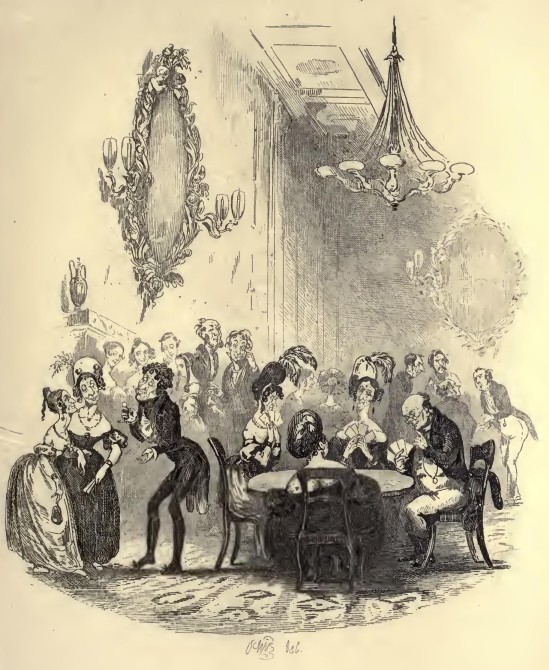

Mr. Pickwick bowed to each of the ladies, and, finding escape impossible, cut. Mr. Pickwick and Miss Bolo against Lady Snuphanuph and Mrs. Colonel Wugsby.
As the trump card was turned up, at the commencement of the second deal, two young ladies hurried into the room, and took their stations on either side of Mrs. Colonel Wugsby’s chair, where they waited patiently until the hand was over.
‘Now, Jane,’ said Mrs. Colonel Wugsby, turning to one of the girls, ‘what is it?’
I came to ask, ma, whether I might dance with the youngest Mr. Crawley,’ whispered the prettier and younger of the two.
‘Good God, Jane, how can you think of such things?’ replied the mamma indignantly. ‘Haven’t you repeatedly heard that his father has eight hundred a year, which dies with him? I am ashamed of you. Not on any account.’
‘Ma,’ whispered the other, who was much older than her sister, and very insipid and artificial, ‘Lord Mutanhed has been introduced to me. I said I thought I wasn’t engaged, ma.’
‘You’re a sweet pet, my love,’ replied Mrs. Colonel Wugsby, tapping her daughter’s cheek with her fan, ‘and are always to be trusted. He’s immensely rich, my dear. Bless you!’ With these words Mrs. Colonel Wugsby kissed her eldest daughter most affectionately, and frowning in a warning manner upon the other, sorted her cards.
Poor Mr. Pickwick! he had never played with three thorough-paced female card-players before. They were so desperately sharp, that they quite frightened him. If he played a wrong card, Miss Bolo looked a small armoury of daggers; if he stopped to consider which was the right one, Lady Snuphanuph would throw herself back in her chair, and smile with a mingled glance of impatience and pity to Mrs. Colonel Wugsby, at which Mrs. Colonel Wugsby would shrug up her shoulders, and cough, as much as to say she wondered whether he ever would begin. Then, at the end of every hand, Miss Bolo would inquire with a dismal countenance and reproachful sigh, why Mr. Pickwick had not returned that diamond, or led the club, or roughed the spade, or finessed the heart, or led through the honour, or brought out the ace, or played up to the king, or some such thing; and in reply to all these grave charges, Mr. Pickwick would be wholly unable to plead any justification whatever, having by this time forgotten all about the game. People came and looked on, too, which made Mr. Pickwick nervous. Besides all this, there was a great deal of distracting conversation near the table, between Angelo Bantam and the two Misses Matinter, who, being single and singular, paid great court to the Master of the Ceremonies, in the hope of getting a stray partner now and then. All these things, combined with the noises and interruptions of constant comings in and goings out, made Mr. Pickwick play rather badly; the cards were against him, also; and when they left off at ten minutes past eleven, Miss Bolo rose from the table considerably agitated, and went straight home, in a flood of tears and a sedan-chair.
Being joined by his friends, who one and all protested that they had scarcely ever spent a more pleasant evening, Mr. Pickwick accompanied them to the White Hart, and having soothed his feelings with something hot, went to bed, and to sleep, almost simultaneously.
CHAPTER XXXVI. THE CHIEF FEATURES OF WHICH WILL BE FOUND TO BE AN AUTHENTIC VERSION OF THE LEGEND OF PRINCE BLADUD, AND A MOST EXTRAORDINARY CALAMITY THAT BEFELL MR. WINKLE
As Mr. Pickwick contemplated a stay of at least two months in Bath, he deemed it advisable to take private lodgings for himself and friends for that period; and as a favourable opportunity offered for their securing, on moderate terms, the upper portion of a house in the Royal Crescent, which was larger than they required, Mr. and Mrs. Dowler offered to relieve them of a bedroom and sitting-room. This proposition was at once accepted, and in three days’ time they were all located in their new abode, when Mr. Pickwick began to drink the waters with the utmost assiduity. Mr. Pickwick took them systematically. He drank a quarter of a pint before breakfast, and then walked up a hill; and another quarter of a pint after breakfast, and then walked down a hill; and, after every fresh quarter of a pint, Mr. Pickwick declared, in the most solemn and emphatic terms, that he felt a great deal better; whereat his friends were very much delighted, though they had not been previously aware that there was anything the matter with him.
The Great Pump Room is a spacious saloon, ornamented with Corinthian pillars, and a music-gallery, and a Tompion clock, and a statue of Nash, and a golden inscription, to which all the water-drinkers should attend, for it appeals to them in the cause of a deserving charity. There is a large bar with a marble vase, out of which the pumper gets the water; and there are a number of yellow-looking tumblers, out of which the company get it; and it is a most edifying and satisfactory sight to behold the perseverance and gravity with which they swallow it. There are baths near at hand, in which a part of the company wash themselves; and a band plays afterwards, to congratulate the remainder on their having done so. There is another pump room, into which infirm ladies and gentlemen are wheeled, in such an astonishing variety of chairs and chaises, that any adventurous individual who goes in with the regular number of toes, is in imminent danger of coming out without them; and there is a third, into which the quiet people go, for it is less noisy than either. There is an immensity of promenading, on crutches and off, with sticks and without, and a great deal of conversation, and liveliness, and pleasantry.
Every morning, the regular water-drinkers, Mr. Pickwick among the number, met each other in the pump room, took their quarter of a pint, and walked constitutionally. At the afternoon’s promenade, Lord Mutanhed, and the Honourable Mr. Crushton, the Dowager Lady Snuphanuph, Mrs. Colonel Wugsby, and all the great people, and all the morning water-drinkers, met in grand assemblage. After this, they walked out, or drove out, or were pushed out in bath-chairs, and met one another again. After this, the gentlemen went to the reading-rooms, and met divisions of the mass. After this, they went home. If it were theatre-night, perhaps they met at the theatre; if it were assembly-night, they met at the rooms; and if it were neither, they met the next day. A very pleasant routine, with perhaps a slight tinge of sameness.
Mr. Pickwick was sitting up by himself, after a day spent in this manner, making entries in his journal, his friends having retired to bed, when he was roused by a gentle tap at the room door.
‘Beg your pardon, Sir,’ said Mrs. Craddock, the landlady, peeping in; ‘but did you want anything more, sir?’
‘Nothing more, ma’am,’ replied Mr. Pickwick.
‘My young girl is gone to bed, Sir,’ said Mrs. Craddock; ‘and Mr. Dowler is good enough to say that he’ll sit up for Mrs. Dowler, as the party isn’t expected to be over till late; so I was thinking that if you wanted nothing more, Mr. Pickwick, I would go to bed.’
‘By all means, ma’am,’ replied Mr. Pickwick.
‘Wish you good-night, Sir,’ said Mrs. Craddock.
‘Good-night, ma’am,’ rejoined Mr. Pickwick.
Mrs. Craddock closed the door, and Mr. Pickwick resumed his writing.
In half an hour’s time the entries were concluded. Mr. Pickwick carefully rubbed the last page on the blotting-paper, shut up the book, wiped his pen on the bottom of the inside of his coat tail, and opened the drawer of the inkstand to put it carefully away. There were a couple of sheets of writing-paper, pretty closely written over, in the inkstand drawer, and they were folded so, that the title, which was in a good round hand, was fully disclosed to him. Seeing from this, that it was no private document; and as it seemed to relate to Bath, and was very short: Mr. Pick-wick unfolded it, lighted his bedroom candle that it might burn up well by the time he finished; and drawing his chair nearer the fire, read as follows—
‘Less than two hundred years ago, on one of the public baths in this city, there appeared an inscription in honour of its mighty founder, the renowned Prince Bladud. That inscription is now erased.
‘For many hundred years before that time, there had been handed down, from age to age, an old legend, that the illustrious prince being afflicted with leprosy, on his return from reaping a rich harvest of knowledge in Athens, shunned the court of his royal father, and consorted moodily with husbandman and pigs. Among the herd (so said the legend) was a pig of grave and solemn countenance, with whom the prince had a fellow-feeling—for he too was wise—a pig of thoughtful and reserved demeanour; an animal superior to his fellows, whose grunt was terrible, and whose bite was sharp. The young prince sighed deeply as he looked upon the countenance of the majestic swine; he thought of his royal father, and his eyes were bedewed with tears.
‘This sagacious pig was fond of bathing in rich, moist mud. Not in summer, as common pigs do now, to cool themselves, and did even in those distant ages (which is a proof that the light of civilisation had already begun to dawn, though feebly), but in the cold, sharp days of winter. His coat was ever so sleek, and his complexion so clear, that the prince resolved to essay the purifying qualities of the same water that his friend resorted to. He made the trial. Beneath that black mud, bubbled the hot springs of Bath. He washed, and was cured. Hastening to his father’s court, he paid his best respects, and returning quickly hither, founded this city and its famous baths.
‘He sought the pig with all the ardour of their early friendship—but, alas! the waters had been his death. He had imprudently taken a bath at too high a temperature, and the natural philosopher was no more! He was succeeded by Pliny, who also fell a victim to his thirst for knowledge.
‘This was the legend. Listen to the true one.
‘A great many centuries since, there flourished, in great state, the famous and renowned Lud Hudibras, king of Britain. He was a mighty monarch. The earth shook when he walked—he was so very stout. His people basked in the light of his countenance—it was so red and glowing. He was, indeed, every inch a king. And there were a good many inches of him, too, for although he was not very tall, he was a remarkable size round, and the inches that he wanted in height, he made up in circumference. If any degenerate monarch of modern times could be in any way compared with him, I should say the venerable King Cole would be that illustrious potentate.
‘This good king had a queen, who eighteen years before, had had a son, who was called Bladud. He was sent to a preparatory seminary in his father’s dominions until he was ten years old, and was then despatched, in charge of a trusty messenger, to a finishing school at Athens; and as there was no extra charge for remaining during the holidays, and no notice required previous to the removal of a pupil, there he remained for eight long years, at the expiration of which time, the king his father sent the lord chamberlain over, to settle the bill, and to bring him home; which, the lord chamberlain doing, was received with shouts, and pensioned immediately.
‘When King Lud saw the prince his son, and found he had grown up such a fine young man, he perceived what a grand thing it would be to have him married without delay, so that his children might be the means of perpetuating the glorious race of Lud, down to the very latest ages of the world. With this view, he sent a special embassy, composed of great noblemen who had nothing particular to do, and wanted lucrative employment, to a neighbouring king, and demanded his fair daughter in marriage for his son; stating at the same time that he was anxious to be on the most affectionate terms with his brother and friend, but that if they couldn’t agree in arranging this marriage, he should be under the unpleasant necessity of invading his kingdom and putting his eyes out. To this, the other king (who was the weaker of the two) replied that he was very much obliged to his friend and brother for all his goodness and magnanimity, and that his daughter was quite ready to be married, whenever Prince Bladud liked to come and fetch her.
‘This answer no sooner reached Britain, than the whole nation was transported with joy. Nothing was heard, on all sides, but the sounds of feasting and revelry—except the chinking of money as it was paid in by the people to the collector of the royal treasures, to defray the expenses of the happy ceremony. It was upon this occasion that King Lud, seated on the top of his throne in full council, rose, in the exuberance of his feelings, and commanded the lord chief justice to order in the richest wines and the court minstrels—an act of graciousness which has been, through the ignorance of traditionary historians, attributed to King Cole, in those celebrated lines in which his Majesty is represented as
And calling for his fiddlers three.
Which is an obvious injustice to the memory of King Lud, and a dishonest exaltation of the virtues of King Cole.
‘But, in the midst of all this festivity and rejoicing, there was one individual present, who tasted not when the sparkling wines were poured forth, and who danced not, when the minstrels played. This was no other than Prince Bladud himself, in honour of whose happiness a whole people were, at that very moment, straining alike their throats and purse-strings. The truth was, that the prince, forgetting the undoubted right of the minister for foreign affairs to fall in love on his behalf, had, contrary to every precedent of policy and diplomacy, already fallen in love on his own account, and privately contracted himself unto the fair daughter of a noble Athenian.
‘Here we have a striking example of one of the manifold advantages of civilisation and refinement. If the prince had lived in later days, he might at once have married the object of his father’s choice, and then set himself seriously to work, to relieve himself of the burden which rested heavily upon him. He might have endeavoured to break her heart by a systematic course of insult and neglect; or, if the spirit of her sex, and a proud consciousness of her many wrongs had upheld her under this ill-treatment, he might have sought to take her life, and so get rid of her effectually. But neither mode of relief suggested itself to Prince Bladud; so he solicited a private audience, and told his father.
‘It is an old prerogative of kings to govern everything but their passions. King Lud flew into a frightful rage, tossed his crown up to the ceiling, and caught it again—for in those days kings kept their crowns on their heads, and not in the Tower—stamped the ground, rapped his forehead, wondered why his own flesh and blood rebelled against him, and, finally, calling in his guards, ordered the prince away to instant Confinement in a lofty turret; a course of treatment which the kings of old very generally pursued towards their sons, when their matrimonial inclinations did not happen to point to the same quarter as their own.
‘When Prince Bladud had been shut up in the lofty turret for the greater part of a year, with no better prospect before his bodily eyes than a stone wall, or before his mental vision than prolonged imprisonment, he naturally began to ruminate on a plan of escape, which, after months of preparation, he managed to accomplish; considerately leaving his dinner-knife in the heart of his jailer, lest the poor fellow (who had a family) should be considered privy to his flight, and punished accordingly by the infuriated king.
‘The monarch was frantic at the loss of his son. He knew not on whom to vent his grief and wrath, until fortunately bethinking himself of the lord chamberlain who had brought him home, he struck off his pension and his head together.
‘Meanwhile, the young prince, effectually disguised, wandered on foot through his father’s dominions, cheered and supported in all his hardships by sweet thoughts of the Athenian maid, who was the innocent cause of his weary trials. One day he stopped to rest in a country village; and seeing that there were gay dances going forward on the green, and gay faces passing to and fro, ventured to inquire of a reveller who stood near him, the reason for this rejoicing.
‘“Know you not, O stranger,” was the reply, “of the recent proclamation of our gracious king?”
‘“Proclamation! No. What proclamation?” rejoined the prince—for he had travelled along the by and little-frequented ways, and knew nothing of what had passed upon the public roads, such as they were.
‘“Why,” replied the peasant, “the foreign lady that our prince wished to wed, is married to a foreign noble of her own country, and the king proclaims the fact, and a great public festival besides; for now, of course, Prince Bladud will come back and marry the lady his father chose, who they say is as beautiful as the noonday sun. Your health, sir. God save the king!”
‘The prince remained to hear no more. He fled from the spot, and plunged into the thickest recesses of a neighbouring wood. On, on, he wandered, night and day; beneath the blazing sun, and the cold pale moon; through the dry heat of noon, and the damp cold of night; in the gray light of morn, and the red glare of eve. So heedless was he of time or object, that being bound for Athens, he wandered as far out of his way as Bath.
‘There was no city where Bath stands, then. There was no vestige of human habitation, or sign of man’s resort, to bear the name; but there was the same noble country, the same broad expanse of hill and dale, the same beautiful channel stealing on, far away, the same lofty mountains which, like the troubles of life, viewed at a distance, and partially obscured by the bright mist of its morning, lose their ruggedness and asperity, and seem all ease and softness. Moved by the gentle beauty of the scene, the prince sank upon the green turf, and bathed his swollen feet in his tears.
‘“Oh!” said the unhappy Bladud, clasping his hands, and mournfully raising his eyes towards the sky, “would that my wanderings might end here! Would that these grateful tears with which I now mourn hope misplaced, and love despised, might flow in peace for ever!”
‘The wish was heard. It was in the time of the heathen deities, who used occasionally to take people at their words, with a promptness, in some cases, extremely awkward. The ground opened beneath the prince’s feet; he sank into the chasm; and instantaneously it closed upon his head for ever, save where his hot tears welled up through the earth, and where they have continued to gush forth ever since.
‘It is observable that, to this day, large numbers of elderly ladies and gentlemen who have been disappointed in procuring partners, and almost as many young ones who are anxious to obtain them, repair annually to Bath to drink the waters, from which they derive much strength and comfort. This is most complimentary to the virtue of Prince Bladud’s tears, and strongly corroborative of the veracity of this legend.’
Mr. Pickwick yawned several times when he had arrived at the end of this little manuscript, carefully refolded, and replaced it in the inkstand drawer, and then, with a countenance expressive of the utmost weariness, lighted his chamber candle, and went upstairs to bed.
He stopped at Mr. Dowler’s door, according to custom, and knocked to say good-night.
‘Ah!’ said Dowler, ‘going to bed? I wish I was. Dismal night. Windy; isn’t it?’
‘Very,’ said Mr. Pickwick. ‘Good-night.’
‘Good-night.’
Mr. Pickwick went to his bedchamber, and Mr. Dowler resumed his seat before the fire, in fulfilment of his rash promise to sit up till his wife came home.
There are few things more worrying than sitting up for somebody, especially if that somebody be at a party. You cannot help thinking how quickly the time passes with them, which drags so heavily with you; and the more you think of this, the more your hopes of their speedy arrival decline. Clocks tick so loud, too, when you are sitting up alone, and you seem as if you had an under-garment of cobwebs on. First, something tickles your right knee, and then the same sensation irritates your left. You have no sooner changed your position, than it comes again in the arms; when you have fidgeted your limbs into all sorts of queer shapes, you have a sudden relapse in the nose, which you rub as if to rub it off—as there is no doubt you would, if you could. Eyes, too, are mere personal inconveniences; and the wick of one candle gets an inch and a half long, while you are snuffing the other. These, and various other little nervous annoyances, render sitting up for a length of time after everybody else has gone to bed, anything but a cheerful amusement.
This was just Mr. Dowler’s opinion, as he sat before the fire, and felt honestly indignant with all the inhuman people at the party who were keeping him up. He was not put into better humour either, by the reflection that he had taken it into his head, early in the evening, to think he had got an ache there, and so stopped at home. At length, after several droppings asleep, and fallings forward towards the bars, and catchings backward soon enough to prevent being branded in the face, Mr. Dowler made up his mind that he would throw himself on the bed in the back room and think—not sleep, of course.
‘I’m a heavy sleeper,’ said Mr. Dowler, as he flung himself on the bed. ‘I must keep awake. I suppose I shall hear a knock here. Yes. I thought so. I can hear the watchman. There he goes. Fainter now, though. A little fainter. He’s turning the corner. Ah!’ When Mr. Dowler arrived at this point, he turned the corner at which he had been long hesitating, and fell fast asleep.
Just as the clock struck three, there was blown into the crescent a sedan-chair with Mrs. Dowler inside, borne by one short, fat chairman, and one long, thin one, who had had much ado to keep their bodies perpendicular: to say nothing of the chair. But on that high ground, and in the crescent, which the wind swept round and round as if it were going to tear the paving stones up, its fury was tremendous. They were very glad to set the chair down, and give a good round loud double-knock at the street door.
They waited some time, but nobody came.
‘Servants is in the arms o’ Porpus, I think,’ said the short chairman, warming his hands at the attendant link-boy’s torch.
‘I wish he’d give ‘em a squeeze and wake ‘em,’ observed the long one.
‘Knock again, will you, if you please,’ cried Mrs. Dowler from the chair. ‘Knock two or three times, if you please.’
The short man was quite willing to get the job over, as soon as possible; so he stood on the step, and gave four or five most startling double-knocks, of eight or ten knocks a-piece, while the long man went into the road, and looked up at the windows for a light.
Nobody came. It was all as silent and dark as ever.
‘Dear me!’ said Mrs. Dowler. ‘You must knock again, if you please.’
There ain’t a bell, is there, ma’am?’ said the short chairman.
‘Yes, there is,’ interposed the link-boy, ‘I’ve been a-ringing at it ever so long.’
‘It’s only a handle,’ said Mrs. Dowler, ‘the wire’s broken.’
‘I wish the servants’ heads wos,’ growled the long man.
‘I must trouble you to knock again, if you please,’ said Mrs. Dowler, with the utmost politeness.
The short man did knock again several times, without producing the smallest effect. The tall man, growing very impatient, then relieved him, and kept on perpetually knocking double-knocks of two loud knocks each, like an insane postman.
At length Mr. Winkle began to dream that he was at a club, and that the members being very refractory, the chairman was obliged to hammer the table a good deal to preserve order; then he had a confused notion of an auction room where there were no bidders, and the auctioneer was buying everything in; and ultimately he began to think it just within the bounds of possibility that somebody might be knocking at the street door. To make quite certain, however, he remained quiet in bed for ten minutes or so, and listened; and when he had counted two or three-and-thirty knocks, he felt quite satisfied, and gave himself a great deal of credit for being so wakeful.
‘Rap rap-rap rap-rap rap-ra, ra, ra, ra, ra, rap!’ went the knocker.
Mr. Winkle jumped out of bed, wondering very much what could possibly be the matter, and hastily putting on his stockings and slippers, folded his dressing-gown round him, lighted a flat candle from the rush-light that was burning in the fireplace, and hurried downstairs.
‘Here’s somebody comin’ at last, ma’am,’ said the short chairman.
‘I wish I wos behind him vith a bradawl,’ muttered the long one.
‘Who’s there?’ cried Mr. Winkle, undoing the chain.
‘Don’t stop to ask questions, cast-iron head,’ replied the long man, with great disgust, taking it for granted that the inquirer was a footman; ‘but open the door.’
‘Come, look sharp, timber eyelids,’ added the other encouragingly.
Mr. Winkle, being half asleep, obeyed the command mechanically, opened the door a little, and peeped out. The first thing he saw, was the red glare of the link-boy’s torch. Startled by the sudden fear that the house might be on fire, he hastily threw the door wide open, and holding the candle above his head, stared eagerly before him, not quite certain whether what he saw was a sedan-chair or a fire-engine. At this instant there came a violent gust of wind; the light was blown out; Mr. Winkle felt himself irresistibly impelled on to the steps; and the door blew to, with a loud crash.
‘Well, young man, now you have done it!’ said the short chairman.
Mr. Winkle, catching sight of a lady’s face at the window of the sedan, turned hastily round, plied the knocker with all his might and main, and called frantically upon the chairman to take the chair away again.
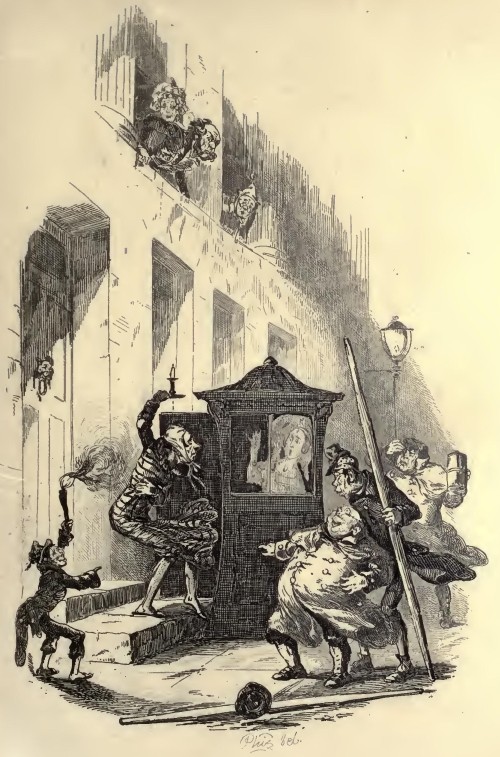
‘Take it away, take it away,’ cried Mr. Winkle. ‘Here’s somebody coming out of another house; put me into the chair. Hide me! Do something with me!’
All this time he was shivering with cold; and every time he raised his hand to the knocker, the wind took the dressing-gown in a most unpleasant manner.
‘The people are coming down the crescent now. There are ladies with ‘em; cover me up with something. Stand before me!’ roared Mr. Winkle. But the chairmen were too much exhausted with laughing to afford him the slightest assistance, and the ladies were every moment approaching nearer and nearer.
Mr. Winkle gave a last hopeless knock; the ladies were only a few doors off. He threw away the extinguished candle, which, all this time he had held above his head, and fairly bolted into the sedan-chair where Mrs. Dowler was.
Now, Mrs. Craddock had heard the knocking and the voices at last; and, only waiting to put something smarter on her head than her nightcap, ran down into the front drawing-room to make sure that it was the right party. Throwing up the window-sash as Mr. Winkle was rushing into the chair, she no sooner caught sight of what was going forward below, than she raised a vehement and dismal shriek, and implored Mr. Dowler to get up directly, for his wife was running away with another gentleman.
Upon this, Mr. Dowler bounced off the bed as abruptly as an India-rubber ball, and rushing into the front room, arrived at one window just as Mr. Pickwick threw up the other, when the first object that met the gaze of both, was Mr. Winkle bolting into the sedan-chair.
‘Watchman,’ shouted Dowler furiously, ‘stop him—hold him—keep him tight—shut him in, till I come down. I’ll cut his throat—give me a knife—from ear to ear, Mrs. Craddock—I will!’ And breaking from the shrieking landlady, and from Mr. Pickwick, the indignant husband seized a small supper-knife, and tore into the street.
But Mr. Winkle didn’t wait for him. He no sooner heard the horrible threat of the valorous Dowler, than he bounced out of the sedan, quite as quickly as he had bounced in, and throwing off his slippers into the road, took to his heels and tore round the crescent, hotly pursued by Dowler and the watchman. He kept ahead; the door was open as he came round the second time; he rushed in, slammed it in Dowler’s face, mounted to his bedroom, locked the door, piled a wash-hand-stand, chest of drawers, and a table against it, and packed up a few necessaries ready for flight with the first ray of morning.
Dowler came up to the outside of the door; avowed, through the keyhole, his steadfast determination of cutting Mr. Winkle’s throat next day; and, after a great confusion of voices in the drawing-room, amidst which that of Mr. Pickwick was distinctly heard endeavouring to make peace, the inmates dispersed to their several bed-chambers, and all was quiet once more.
It is not unlikely that the inquiry may be made, where Mr. Weller was, all this time? We will state where he was, in the next chapter.
CHAPTER XXXVII. HONOURABLY ACCOUNTS FOR MR. WELLER’S ABSENCE, BY DESCRIBING A SOIREE TO WHICH HE WAS INVITED AND WENT; ALSO RELATES HOW HE WAS ENTRUSTED BY MR. PICKWICK WITH A PRIVATE MISSION OF DELICACY AND IMPORTANCE
Mr. Weller,’ said Mrs. Craddock, upon the morning of this very eventful day, ‘here’s a letter for you.’
‘Wery odd that,’ said Sam; ‘I’m afeerd there must be somethin’ the matter, for I don’t recollect any gen’l’m’n in my circle of acquaintance as is capable o’ writin’ one.’
‘Perhaps something uncommon has taken place,’ observed Mrs. Craddock.
‘It must be somethin’ wery uncommon indeed, as could perduce a letter out o’ any friend o’ mine,’ replied Sam, shaking his head dubiously; ‘nothin’ less than a nat’ral conwulsion, as the young gen’l’m’n observed ven he wos took with fits. It can’t be from the gov’ner,’ said Sam, looking at the direction. ‘He always prints, I know, ‘cos he learnt writin’ from the large bills in the booking-offices. It’s a wery strange thing now, where this here letter can ha’ come from.’
As Sam said this, he did what a great many people do when they are uncertain about the writer of a note—looked at the seal, and then at the front, and then at the back, and then at the sides, and then at the superscription; and, as a last resource, thought perhaps he might as well look at the inside, and try to find out from that.
‘It’s wrote on gilt-edged paper,’ said Sam, as he unfolded it, ‘and sealed in bronze vax vith the top of a door key. Now for it.’ And, with a very grave face, Mr. Weller slowly read as follows—
‘A select company of the Bath footmen presents their compliments to Mr. Weller, and requests the pleasure of his company this evening, to a friendly swarry, consisting of a boiled leg of mutton with the usual trimmings. The swarry to be on table at half-past nine o’clock punctually.’
This was inclosed in another note, which ran thus—
‘Mr. John Smauker, the gentleman who had the pleasure of meeting Mr. Weller at the house of their mutual acquaintance, Mr. Bantam, a few days since, begs to inclose Mr. Weller the herewith invitation. If Mr. Weller will call on Mr. John Smauker at nine o’clock, Mr. John Smauker will have the pleasure of introducing Mr. Weller.
The envelope was directed to blank Weller, Esq., at Mr. Pickwick’s; and in a parenthesis, in the left hand corner, were the words ‘airy bell,’ as an instruction to the bearer.
‘Vell,’ said Sam, ‘this is comin’ it rayther powerful, this is. I never heerd a biled leg o’ mutton called a swarry afore. I wonder wot they’d call a roast one.’
However, without waiting to debate the point, Sam at once betook himself into the presence of Mr. Pickwick, and requested leave of absence for that evening, which was readily granted. With this permission and the street-door key, Sam Weller issued forth a little before the appointed time, and strolled leisurely towards Queen Square, which he no sooner gained than he had the satisfaction of beholding Mr. John Smauker leaning his powdered head against a lamp-post at a short distance off, smoking a cigar through an amber tube.
‘How do you do, Mr. Weller?’ said Mr. John Smauker, raising his hat gracefully with one hand, while he gently waved the other in a condescending manner. ‘How do you do, Sir?’
‘Why, reasonably conwalessent,’ replied Sam. ‘How do you find yourself, my dear feller?’
‘Only so so,’ said Mr. John Smauker.
‘Ah, you’ve been a-workin’ too hard,’ observed Sam. ‘I was fearful you would; it won’t do, you know; you must not give way to that ‘ere uncompromisin’ spirit o’ yourn.’
‘It’s not so much that, Mr. Weller,’ replied Mr. John Smauker, ‘as bad wine; I’m afraid I’ve been dissipating.’
‘Oh! that’s it, is it?’ said Sam; ‘that’s a wery bad complaint, that.’
‘And yet the temptation, you see, Mr. Weller,’ observed Mr. John Smauker.
‘Ah, to be sure,’ said Sam.
‘Plunged into the very vortex of society, you know, Mr. Weller,’ said Mr. John Smauker, with a sigh.
‘Dreadful, indeed!’ rejoined Sam.
‘But it’s always the way,’ said Mr. John Smauker; ‘if your destiny leads you into public life, and public station, you must expect to be subjected to temptations which other people is free from, Mr. Weller.’
‘Precisely what my uncle said, ven he vent into the public line,’ remarked Sam, ‘and wery right the old gen’l’m’n wos, for he drank hisself to death in somethin’ less than a quarter.’
Mr. John Smauker looked deeply indignant at any parallel being drawn between himself and the deceased gentleman in question; but, as Sam’s face was in the most immovable state of calmness, he thought better of it, and looked affable again.
‘Perhaps we had better be walking,’ said Mr. Smauker, consulting a copper timepiece which dwelt at the bottom of a deep watch-pocket, and was raised to the surface by means of a black string, with a copper key at the other end.
‘P’raps we had,’ replied Sam, ‘or they’ll overdo the swarry, and that’ll spile it.’
‘Have you drank the waters, Mr. Weller?’ inquired his companion, as they walked towards High Street.
‘Once,’ replied Sam.
‘What did you think of ‘em, Sir?’
‘I thought they was particklery unpleasant,’ replied Sam.
‘Ah,’ said Mr. John Smauker, ‘you disliked the killibeate taste, perhaps?’
‘I don’t know much about that ‘ere,’ said Sam. ‘I thought they’d a wery strong flavour o’ warm flat irons.’
‘That is the killibeate, Mr. Weller,’ observed Mr. John Smauker contemptuously.
‘Well, if it is, it’s a wery inexpressive word, that’s all,’ said Sam. ‘It may be, but I ain’t much in the chimical line myself, so I can’t say.’ And here, to the great horror of Mr. John Smauker, Sam Weller began to whistle.
‘I beg your pardon, Mr. Weller,’ said Mr. John Smauker, agonised at the exceeding ungenteel sound, ‘will you take my arm?’
‘Thank’ee, you’re wery good, but I won’t deprive you of it,’ replied Sam. ‘I’ve rayther a way o’ putting my hands in my pockets, if it’s all the same to you.’ As Sam said this, he suited the action to the word, and whistled far louder than before.
‘This way,’ said his new friend, apparently much relieved as they turned down a by-street; ‘we shall soon be there.’
‘Shall we?’ said Sam, quite unmoved by the announcement of his close vicinity to the select footmen of Bath.
‘Yes,’ said Mr. John Smauker. ‘Don’t be alarmed, Mr. Weller.’
‘Oh, no,’ said Sam.
‘You’ll see some very handsome uniforms, Mr. Weller,’ continued Mr. John Smauker; ‘and perhaps you’ll find some of the gentlemen rather high at first, you know, but they’ll soon come round.’
‘That’s wery kind on ‘em,’ replied Sam.
‘And you know,’ resumed Mr. John Smauker, with an air of sublime protection—‘you know, as you’re a stranger, perhaps, they’ll be rather hard upon you at first.’
‘They won’t be wery cruel, though, will they?’ inquired Sam.
‘No, no,’ replied Mr. John Smauker, pulling forth the fox’s head, and taking a gentlemanly pinch. ‘There are some funny dogs among us, and they will have their joke, you know; but you mustn’t mind ‘em, you mustn’t mind ‘em.’
‘I’ll try and bear up agin such a reg’lar knock down o’ talent,’ replied Sam.
‘That’s right,’ said Mr. John Smauker, putting forth his fox’s head, and elevating his own; ‘I’ll stand by you.’
By this time they had reached a small greengrocer’s shop, which Mr. John Smauker entered, followed by Sam, who, the moment he got behind him, relapsed into a series of the very broadest and most unmitigated grins, and manifested other demonstrations of being in a highly enviable state of inward merriment.
Crossing the greengrocer’s shop, and putting their hats on the stairs in the little passage behind it, they walked into a small parlour; and here the full splendour of the scene burst upon Mr. Weller’s view.
A couple of tables were put together in the middle of the parlour, covered with three or four cloths of different ages and dates of washing, arranged to look as much like one as the circumstances of the case would allow. Upon these were laid knives and forks for six or eight people. Some of the knife handles were green, others red, and a few yellow; and as all the forks were black, the combination of colours was exceedingly striking. Plates for a corresponding number of guests were warming behind the fender; and the guests themselves were warming before it: the chief and most important of whom appeared to be a stoutish gentleman in a bright crimson coat with long tails, vividly red breeches, and a cocked hat, who was standing with his back to the fire, and had apparently just entered, for besides retaining his cocked hat on his head, he carried in his hand a high stick, such as gentlemen of his profession usually elevate in a sloping position over the roofs of carriages.
‘Smauker, my lad, your fin,’ said the gentleman with the cocked hat.
Mr. Smauker dovetailed the top joint of his right-hand little finger into that of the gentleman with the cocked hat, and said he was charmed to see him looking so well.
‘Well, they tell me I am looking pretty blooming,’ said the man with the cocked hat, ‘and it’s a wonder, too. I’ve been following our old woman about, two hours a day, for the last fortnight; and if a constant contemplation of the manner in which she hooks-and-eyes that infernal lavender-coloured old gown of hers behind, isn’t enough to throw anybody into a low state of despondency for life, stop my quarter’s salary.’
At this, the assembled selections laughed very heartily; and one gentleman in a yellow waistcoat, with a coach-trimming border, whispered a neighbour in green-foil smalls, that Tuckle was in spirits to-night.
‘By the bye,’ said Mr. Tuckle, ‘Smauker, my boy, you—’ The remainder of the sentence was forwarded into Mr. John Smauker’s ear, by whisper.
‘Oh, dear me, I quite forgot,’ said Mr. John Smauker. ‘Gentlemen, my friend Mr. Weller.’
‘Sorry to keep the fire off you, Weller,’ said Mr. Tuckle, with a familiar nod. ‘Hope you’re not cold, Weller.’
‘Not by no means, Blazes,’ replied Sam. ‘It ‘ud be a wery chilly subject as felt cold wen you stood opposite. You’d save coals if they put you behind the fender in the waitin’-room at a public office, you would.’
As this retort appeared to convey rather a personal allusion to Mr. Tuckle’s crimson livery, that gentleman looked majestic for a few seconds, but gradually edging away from the fire, broke into a forced smile, and said it wasn’t bad.
‘Wery much obliged for your good opinion, sir,’ replied Sam. ‘We shall get on by degrees, I des-say. We’ll try a better one by and bye.’
At this point the conversation was interrupted by the arrival of a gentleman in orange-coloured plush, accompanied by another selection in purple cloth, with a great extent of stocking. The new-comers having been welcomed by the old ones, Mr. Tuckle put the question that supper be ordered in, which was carried unanimously.
The greengrocer and his wife then arranged upon the table a boiled leg of mutton, hot, with caper sauce, turnips, and potatoes. Mr. Tuckle took the chair, and was supported at the other end of the board by the gentleman in orange plush. The greengrocer put on a pair of wash-leather gloves to hand the plates with, and stationed himself behind Mr. Tuckle’s chair.
‘Harris,’ said Mr. Tuckle, in a commanding tone.
‘Sir,’ said the greengrocer.
‘Have you got your gloves on?’
Yes, Sir.’
‘Then take the kiver off.’
‘Yes, Sir.’
The greengrocer did as he was told, with a show of great humility, and obsequiously handed Mr. Tuckle the carving-knife; in doing which, he accidentally gaped.
‘What do you mean by that, Sir?’ said Mr. Tuckle, with great asperity.
‘I beg your pardon, Sir,’ replied the crestfallen greengrocer, ‘I didn’t mean to do it, Sir; I was up very late last night, Sir.’
‘I tell you what my opinion of you is, Harris,’ said Mr. Tuckle, with a most impressive air, ‘you’re a wulgar beast.’
‘I hope, gentlemen,’ said Harris, ‘that you won’t be severe with me, gentlemen. I am very much obliged to you indeed, gentlemen, for your patronage, and also for your recommendations, gentlemen, whenever additional assistance in waiting is required. I hope, gentlemen, I give satisfaction.’
‘No, you don’t, Sir,’ said Mr. Tuckle. ‘Very far from it, Sir.’
‘We consider you an inattentive reskel,’ said the gentleman in the orange plush.
‘And a low thief,’ added the gentleman in the green-foil smalls.
‘And an unreclaimable blaygaird,’ added the gentleman in purple.
The poor greengrocer bowed very humbly while these little epithets were bestowed upon him, in the true spirit of the very smallest tyranny; and when everybody had said something to show his superiority, Mr. Tuckle proceeded to carve the leg of mutton, and to help the company.
This important business of the evening had hardly commenced, when the door was thrown briskly open, and another gentleman in a light-blue suit, and leaden buttons, made his appearance.
‘Against the rules,’ said Mr. Tuckle. ‘Too late, too late.’
‘No, no; positively I couldn’t help it,’ said the gentleman in blue. ‘I appeal to the company. An affair of gallantry now, an appointment at the theayter.’
‘Oh, that indeed,’ said the gentleman in the orange plush.
‘Yes; raly now, honour bright,’ said the man in blue. ‘I made a promese to fetch our youngest daughter at half-past ten, and she is such an uncauminly fine gal, that I raly hadn’t the ‘art to disappint her. No offence to the present company, Sir, but a petticut, sir—a petticut, Sir, is irrevokeable.’
‘I begin to suspect there’s something in that quarter,’ said Tuckle, as the new-comer took his seat next Sam, ‘I’ve remarked, once or twice, that she leans very heavy on your shoulder when she gets in and out of the carriage.’
‘Oh, raly, raly, Tuckle, you shouldn’t,’ said the man in blue. ‘It’s not fair. I may have said to one or two friends that she wos a very divine creechure, and had refused one or two offers without any hobvus cause, but—no, no, no, indeed, Tuckle—before strangers, too—it’s not right—you shouldn’t. Delicacy, my dear friend, delicacy!’ And the man in blue, pulling up his neckerchief, and adjusting his coat cuffs, nodded and frowned as if there were more behind, which he could say if he liked, but was bound in honour to suppress.
The man in blue being a light-haired, stiff-necked, free and easy sort of footman, with a swaggering air and pert face, had attracted Mr. Weller’s special attention at first, but when he began to come out in this way, Sam felt more than ever disposed to cultivate his acquaintance; so he launched himself into the conversation at once, with characteristic independence.
‘Your health, Sir,’ said Sam. ‘I like your conversation much. I think it’s wery pretty.’
At this the man in blue smiled, as if it were a compliment he was well used to; but looked approvingly on Sam at the same time, and said he hoped he should be better acquainted with him, for without any flattery at all he seemed to have the makings of a very nice fellow about him, and to be just the man after his own heart.
‘You’re wery good, sir,’ said Sam. ‘What a lucky feller you are!’
‘How do you mean?’ inquired the gentleman in blue.
‘That ‘ere young lady,’ replied Sam. ‘She knows wot’s wot, she does. Ah! I see.’ Mr. Weller closed one eye, and shook his head from side to side, in a manner which was highly gratifying to the personal vanity of the gentleman in blue.
‘I’m afraid you’re a cunning fellow, Mr. Weller,’ said that individual.
‘No, no,’ said Sam. ‘I leave all that ‘ere to you. It’s a great deal more in your way than mine, as the gen’l’m’n on the right side o’ the garden vall said to the man on the wrong un, ven the mad bull vos a-comin’ up the lane.’
‘Well, well, Mr. Weller,’ said the gentleman in blue, ‘I think she has remarked my air and manner, Mr. Weller.’
‘I should think she couldn’t wery well be off o’ that,’ said Sam.
‘Have you any little thing of that kind in hand, sir?’ inquired the favoured gentleman in blue, drawing a toothpick from his waistcoat pocket.
‘Not exactly,’ said Sam. ‘There’s no daughters at my place, else o’ course I should ha’ made up to vun on ‘em. As it is, I don’t think I can do with anythin’ under a female markis. I might keep up with a young ‘ooman o’ large property as hadn’t a title, if she made wery fierce love to me. Not else.’
‘Of course not, Mr. Weller,’ said the gentleman in blue, ‘one can’t be troubled, you know; and we know, Mr. Weller—we, who are men of the world—that a good uniform must work its way with the women, sooner or later. In fact, that’s the only thing, between you and me, that makes the service worth entering into.’
‘Just so,’ said Sam. ‘That’s it, o’ course.’
When this confidential dialogue had gone thus far, glasses were placed round, and every gentleman ordered what he liked best, before the public-house shut up. The gentleman in blue, and the man in orange, who were the chief exquisites of the party, ordered ‘cold shrub and water,’ but with the others, gin-and-water, sweet, appeared to be the favourite beverage. Sam called the greengrocer a ‘desp’rate willin,’ and ordered a large bowl of punch—two circumstances which seemed to raise him very much in the opinion of the selections.
‘Gentlemen,’ said the man in blue, with an air of the most consummate dandyism, ‘I’ll give you the ladies; come.’
‘Hear, hear!’ said Sam. ‘The young mississes.’
Here there was a loud cry of ‘Order,’ and Mr. John Smauker, as the gentleman who had introduced Mr. Weller into that company, begged to inform him that the word he had just made use of, was unparliamentary.
‘Which word was that ‘ere, Sir?’ inquired Sam.
‘Mississes, Sir,’ replied Mr. John Smauker, with an alarming frown. ‘We don’t recognise such distinctions here.’
‘Oh, wery good,’ said Sam; ‘then I’ll amend the obserwation and call ‘em the dear creeturs, if Blazes vill allow me.’
Some doubt appeared to exist in the mind of the gentleman in the green-foil smalls, whether the chairman could be legally appealed to, as ‘Blazes,’ but as the company seemed more disposed to stand upon their own rights than his, the question was not raised. The man with the cocked hat breathed short, and looked long at Sam, but apparently thought it as well to say nothing, in case he should get the worst of it. After a short silence, a gentleman in an embroidered coat reaching down to his heels, and a waistcoat of the same which kept one half of his legs warm, stirred his gin-and-water with great energy, and putting himself upon his feet, all at once by a violent effort, said he was desirous of offering a few remarks to the company, whereupon the person in the cocked hat had no doubt that the company would be very happy to hear any remarks that the man in the long coat might wish to offer.
‘I feel a great delicacy, gentlemen, in coming for’ard,’ said the man in the long coat, ‘having the misforchune to be a coachman, and being only admitted as a honorary member of these agreeable swarrys, but I do feel myself bound, gentlemen—drove into a corner, if I may use the expression—to make known an afflicting circumstance which has come to my knowledge; which has happened I may say within the soap of my everyday contemplation. Gentlemen, our friend Mr. Whiffers (everybody looked at the individual in orange), our friend Mr. Whiffers has resigned.’
Universal astonishment fell upon the hearers. Each gentleman looked in his neighbour’s face, and then transferred his glance to the upstanding coachman.
‘You may well be sapparised, gentlemen,’ said the coachman. ‘I will not wenchure to state the reasons of this irrepairabel loss to the service, but I will beg Mr. Whiffers to state them himself, for the improvement and imitation of his admiring friends.’
The suggestion being loudly approved of, Mr. Whiffers explained. He said he certainly could have wished to have continued to hold the appointment he had just resigned. The uniform was extremely rich and expensive, the females of the family was most agreeable, and the duties of the situation was not, he was bound to say, too heavy; the principal service that was required of him, being, that he should look out of the hall window as much as possible, in company with another gentleman, who had also resigned. He could have wished to have spared that company the painful and disgusting detail on which he was about to enter, but as the explanation had been demanded of him, he had no alternative but to state, boldly and distinctly, that he had been required to eat cold meat.
It is impossible to conceive the disgust which this avowal awakened in the bosoms of the hearers. Loud cries of ‘Shame,’ mingled with groans and hisses, prevailed for a quarter of an hour.
Mr. Whiffers then added that he feared a portion of this outrage might be traced to his own forbearing and accommodating disposition. He had a distinct recollection of having once consented to eat salt butter, and he had, moreover, on an occasion of sudden sickness in the house, so far forgotten himself as to carry a coal-scuttle up to the second floor. He trusted he had not lowered himself in the good opinion of his friends by this frank confession of his faults; and he hoped the promptness with which he had resented the last unmanly outrage on his feelings, to which he had referred, would reinstate him in their good opinion, if he had.
Mr. Whiffers’s address was responded to, with a shout of admiration, and the health of the interesting martyr was drunk in a most enthusiastic manner; for this, the martyr returned thanks, and proposed their visitor, Mr. Weller—a gentleman whom he had not the pleasure of an intimate acquaintance with, but who was the friend of Mr. John Smauker, which was a sufficient letter of recommendation to any society of gentlemen whatever, or wherever. On this account, he should have been disposed to have given Mr. Weller’s health with all the honours, if his friends had been drinking wine; but as they were taking spirits by way of a change, and as it might be inconvenient to empty a tumbler at every toast, he should propose that the honours be understood.
At the conclusion of this speech, everybody took a sip in honour of Sam; and Sam having ladled out, and drunk, two full glasses of punch in honour of himself, returned thanks in a neat speech.
‘Wery much obliged to you, old fellers,’ said Sam, ladling away at the punch in the most unembarrassed manner possible, ‘for this here compliment; which, comin’ from sich a quarter, is wery overvelmin’. I’ve heered a good deal on you as a body, but I will say, that I never thought you was sich uncommon nice men as I find you air. I only hope you’ll take care o’ yourselves, and not compromise nothin’ o’ your dignity, which is a wery charmin’ thing to see, when one’s out a-walkin’, and has always made me wery happy to look at, ever since I was a boy about half as high as the brass-headed stick o’ my wery respectable friend, Blazes, there. As to the wictim of oppression in the suit o’ brimstone, all I can say of him, is, that I hope he’ll get jist as good a berth as he deserves; in vitch case it’s wery little cold swarry as ever he’ll be troubled with agin.’
Here Sam sat down with a pleasant smile, and his speech having been vociferously applauded, the company broke up.
‘Wy, you don’t mean to say you’re a-goin’ old feller?’ said Sam Weller to his friend, Mr. John Smauker.
‘I must, indeed,’ said Mr. Smauker; ‘I promised Bantam.’
‘Oh, wery well,’ said Sam; ‘that’s another thing. P’raps he’d resign if you disappinted him. You ain’t a-goin’, Blazes?’
‘Yes, I am,’ said the man with the cocked hat.
‘Wot, and leave three-quarters of a bowl of punch behind you!’ said Sam; ‘nonsense, set down agin.’
Mr. Tuckle was not proof against this invitation. He laid aside the cocked hat and stick which he had just taken up, and said he would have one glass, for good fellowship’s sake.
As the gentleman in blue went home the same way as Mr. Tuckle, he was prevailed upon to stop too. When the punch was about half gone, Sam ordered in some oysters from the green-grocer’s shop; and the effect of both was so extremely exhilarating, that Mr. Tuckle, dressed out with the cocked hat and stick, danced the frog hornpipe among the shells on the table, while the gentleman in blue played an accompaniment upon an ingenious musical instrument formed of a hair-comb upon a curl-paper. At last, when the punch was all gone, and the night nearly so, they sallied forth to see each other home. Mr. Tuckle no sooner got into the open air, than he was seized with a sudden desire to lie on the curbstone; Sam thought it would be a pity to contradict him, and so let him have his own way. As the cocked hat would have been spoiled if left there, Sam very considerately flattened it down on the head of the gentleman in blue, and putting the big stick in his hand, propped him up against his own street-door, rang the bell, and walked quietly home.